logo
ResearchBunny Logo
Stereochemical engineering yields a multifunctional peptide macrocycle inhibitor of Akt2 by fine-tuning macrocycle-cell membrane interactions

Biology

Stereochemical engineering yields a multifunctional peptide macrocycle inhibitor of Akt2 by fine-tuning macrocycle-cell membrane interactions

A. Nag, A. Mafi, et al.

Uncover the potential of macrocycle peptides in targeting intracellular proteins with the development of a high-affinity peptide ligand that effectively penetrates cell membranes. This groundbreaking research by Arundhati Nag, Amirhossein Mafi, Samir Das, Mary Beth Yu, Belen Alvarez-Villalonga, Soo-Kyung Kim, Yapeng Su, William A. Goddard III, and James R. Heath provides insights into cell-penetrant ligands and their interactions with cholesterol, expanding the toolkit for drug design.... show more
Introduction

The study addresses the challenge of designing cell-penetrant, epitope-specific macrocyclic peptides to target intracellular proteins, focusing on the active (phosphorylated Ser474) epitope of Akt2, a kinase frequently hyperactivated in cancers. Conventional small molecules are effective kinase inhibitors but often require hydrophobic pockets, which disordered regions like the C-terminus of Akt2 lack. Phospho-specific antibodies are effective diagnostic tools but are not cell-penetrant, limiting live-cell applications. The authors propose a development workflow inspired by monoclonal antibody selection and medicinal chemistry: identify a cyclic peptide binder to the pSer474 epitope using chemical epitope targeting (CET), convert it to a biligand via in situ click chemistry to enhance affinity, then independently optimize inhibition and cell penetration. The central hypothesis is that stereochemical fine-tuning of a peptide macrocycle can improve cell penetration without sacrificing affinity or inhibitory function, by modulating interactions with membrane components (notably cholesterol).

Literature Review
  • Phospho-kinase signaling regulates intracellular pathways and is often hyperactivated in cancers, making kinases key therapeutic and diagnostic targets (refs 1–2).
  • Small-molecule inhibitors are standard but require suitable binding pockets; disordered epitopes are challenging. Phospho-specific antibodies are diagnostically valuable but lack cell permeability (ref 3).
  • Macrocyclic peptides can provide high affinity/selectivity and sometimes cell penetration, but most synthetic macrocycles are not inherently cell-penetrant; adding CPPs (e.g., Tat) can introduce toxicity and other liabilities (refs 5–12, 42–45).
  • Prior work showed the disordered C-terminal pSer474 region of Akt2 can be targeted by peptides for allosteric inhibition (ref 16).
  • Strategies to improve peptide permeability include N-methylation, PEGylation, helix stabilization/stapling, and incorporation of noncanonical residues, although these can compromise binding or function (refs 38–41, 46–53).
  • Retro-inversion (full or partial) can preserve topochemical side-chain presentation while enhancing protease stability and sometimes cell penetration, albeit with possible effects on affinity (refs 55–64).
  • Cell uptake often involves multiple endocytosis pathways; membrane composition and cholesterol-dependent lipid rafts can be critical (refs 65–67).
Methodology

Workflow (four phases):

  1. Binding discovery (CET):
  • Synthesized a biotinylated phospho-epitope (SynEp) peptide corresponding to the disordered Akt2 C-terminal region containing pSer474 and a hydrophobic motif. Also prepared a scrambled non-phosphorylated control epitope.
  • Screened a ~2 million element OBOC cyclic peptide library against the scrambled control (to remove false positives) and then against the pSer474 SynEp to identify hits. Sequenced hits by Edman degradation, resynthesized, and tested for binding to full-length pAkt2.
  • Identified macrocycle C1 (EC50 ~120 nM). Explored ring size/linker variants to optimize binding, yielding C2 (Cy(YYTYTG-rcm)) with improved affinity (EC50 44 nM) and selectivity.
  1. Affinity enhancement (biligand formation via in situ click):
  • Appended an azide handle and biotin to C2 to create C2-N1. Built an OBOC linear D-amino acid hexameric alkyne library.
  • Performed protein-templated in situ click (CuAAC) screens with full-length pAkt2 to form C2-linker(L) biligands (Bi,j,k). Cleared binders to the anchor alone, then screened with pAkt2 present.
  • Selected B2,2,1 (linear arm L1 = kyyir) with EC50 13.6 nM; it competed with a commercial pS474 antibody and was selective for pAkt2 over non-phosphorylated Akt2.
  1. Inhibition optimization:
  • Guided by phospho-peptide antibody structures, appended an N-terminal flexible diamino propanoic acid (Dap) to B2,2,1, yielding B3,2,1. B3,2,1 maintained high affinity (KD 12 nM by fluorescence anisotropy) and gained inhibitory activity against kinase function (IC50 8 µM in a pGSK3 readout). Demonstrated selectivity for pAkt2 and pAkt1 over pAkt3 and inactive Akt2; negligible binding to GSK3, p70S6k, Abl2, MEK1.
  1. Cell penetration optimization:
  • Evaluated cell uptake in NIH-OVCAR-3 cells with fluorescein-labeled C2 and B3,2,1; no uptake detected. Conducted alanine scanning: three Tyr and one Gly in the macrocycle were critical for binding. Tried isosteric substitution with 4-fluorophenylalanine (fl-F) (tolerated) and backbone N-methylation in cyclic moiety (abolished binding). Explored linker modifications (helical linkers, α/β amino acids, α,α-disubstituted residues), PEGylation, positive charge incorporation, and aromatic residues; many reduced affinity and/or inhibition. Retained original linker motif (modified to embed the triazole, N2). Introduced N-methylations in the linear arm to increase rigidity (double/triple N-methyls). B4,2,5 (three N-methyls in L, two fl-F in macrocycle) retained affinity (EC50 60.6 nM) but remained non-penetrant.
  • Pursued stereochemical engineering of the macrocycle: full retro-inversion of macrocycle (C4→C5) to yield B5,3,5; partial retro-inversion at Thr β-carbons to yield B7,3,5; variants with C-terminal chirality changes (B6,3,4; B6,3,5). All retro-inverso biligands used D-amino acids and maintained high affinity (~10 nM EC50) to pAkt2.

Functional and uptake assays:

  • Inhibition in cells: serum-starved OVCAR-3 treated with 20 µM unlabeled biligands for 12 h at 37 °C; assessed pGSK3 in lysates by Western blot.
  • Live-cell imaging: EGF stimulate vs non-stimulate; 100 nM FITC-labeled ligands for 16 h; confocal microscopy.
  • Flow cytometry: 200 nM FITC-labeled ligands for 8 h; quantified % FITC+ cells; assessed mechanism by temperature shift (4 °C), ATP depletion (2-deoxy-D-glucose), and pharmacologic inhibitors for macropinocytosis (cytochalasin D), caveolae-mediated (filipin), clathrin-mediated (chlorpromazine), and lipid-raft-mediated (methyl-β-cyclodextrin, MβCD).

Molecular dynamics (MD) and free energy calculations:

  • Built membrane systems (CHARMM-GUI) with POPC bilayer (35 lipids/leaflet) and 20% cholesterol (7/leaflet), water (~6500), 0.15 M NaCl, single biligand (B5,3,5 or B7,3,5).
  • Force fields: CHARMM36m for lipids/ions; TIP3P water; ligand parameters via CGenFF (ParamChem). Simulations in GROMACS; well-tempered metadynamics with PLUMED-2 multiple-walker scheme.
  • Two collective variables: z-distance of macrocycle COM and linear branch COM to bilayer COM. Conducted solution-approach metaMD (~3 µs aggregate) and transmembrane diffusion metaMD (~37 µs aggregate). Analyzed radial distribution functions and non-bonded interaction energies of specific chiral centers with cholesterol; compared diffusion barriers and cholesterol interactions between stereoisomers.
Key Findings
  • Binding and selectivity:

    • Macrocycle discovery and optimization: C1 EC50 ~120 nM (pAkt2); optimized C2 EC50 44 nM with improved selectivity.
    • Biligand via in situ click: B2,2,1 EC50 13.6 nM; competes with commercial pS474 antibody; selective for pAkt2 vs non-phospho Akt2.
    • Inhibition optimization: B3,2,1 KD 12 nM (fluorescence anisotropy), IC50 8 µM for inhibiting pAkt2 (pGSK3 readout). Selective binding to pAkt2 and pAkt1, not pAkt3 or inactive Akt2; negligible binding to GSK3, p70S6k, Abl2, MEK1.
    • N-methylation in the linear arm tolerated; N-methylation in cyclic moiety abrogated binding. fl-F substitutions in macrocycle tolerated and improved protease stability.
  • Cell penetration:

    • Initial constructs (C2, B3,2,1, B4,2,5) were not cell-penetrant by live imaging.
    • Retro-inverso constructs (B5,3,5; B6,3,4; B6,3,5; B7,3,5) maintained high binding (EC50 ≈ 10 nM) and showed functional cellular activity.
    • Unlabeled biligands in functional assay: B5,3,5 reduced pGSK3 in EGF-stimulated OVCAR-3 cells; B6,3,5 (differing only at C-terminal Dap chirality) did not inhibit, highlighting stereochemical sensitivity.
    • Dye-labeled uptake (flow cytometry): at 37 °C, FITC-labeled B7,3,5 and B5,3,5 uptake were ~14% and ~6% FITC+ cells, respectively. Uptake was markedly reduced at 4 °C and by ATP depletion (2-deoxy-D-glucose), implicating endocytosis.
    • Endocytosis inhibitors: B7,3,5 uptake reduced more than B5,3,5 by cytochalasin D (71% vs 46%), filipin (81% vs 25%), and chlorpromazine (67% vs 33%). MβCD most strongly inhibited uptake for both, indicating lipid-raft-mediated endocytosis as a major pathway.
    • Microscopy: B7,3,5 showed stronger cytosolic penetration and punctate endosomal accumulation in stimulated cells; minimal uptake in unstimulated cells.
  • Mechanism via MD simulations:

    • Retro-inversion increased hydrophobic character slightly (hexane affinity −9.1 ± 0.3 kcal/mol for B5,3,5 vs −8.3 ± 0.4 kcal/mol for B4,2,5).
    • Stereochemical change at Thr β-carbons (B7,3,5 vs B5,3,5) did not alter overall hydrophobicity but increased penetration rate ~2–3-fold.
    • Cholesterol interaction differences: CC1 of B5,3,5 contacted ~4.0 cholesterol atoms within 7.5 Å vs ~2.5 for B7,3,5; stronger macrocycle-cholesterol interactions in B5,3,5 correlated with slower diffusion. B7,3,5 adopted conformations that shielded polar residues internally, reducing cholesterol engagement; B5,3,5 exposed polar residues, recruiting additional cholesterol interactions.
    • MetaMD estimated a lowered diffusion barrier for B7,3,5 by ~0.03 eV relative to B5,3,5.
  • Functionality:

    • B7,3,5 and B5,3,5 function as capture agents for immunoprecipitation of pAkt2 from induced cell lysates.
    • Serve as live-cell reagents to visualize Akt activation and as allosteric inhibitors targeting the disordered pS474 epitope.
Discussion

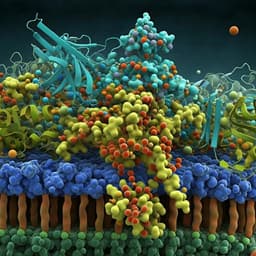
The work demonstrates that a staged, function-specific optimization algorithm can convert a selective, epitope-targeted macrocyclic peptide into a multifunctional, cell-penetrant biligand against a disordered allosteric region (pS474) of Akt2. By decoupling affinity, inhibition, and permeability optimization, the authors retained high target affinity and allosteric inhibition while improving cellular uptake. Critically, stereochemical engineering—retro-inversion of the macrocycle and targeted inversion of Thr β-carbons—enhanced cell penetration without compromising binding or inhibitory characteristics. Mechanistic experiments and metaMD simulations reveal that the improved uptake of B7,3,5 over B5,3,5 arises from reduced biligand–cholesterol interactions within lipid rafts and a modestly lower transmembrane diffusion barrier, aligning with inhibitor studies implicating lipid-raft-mediated endocytosis. These findings address the research goal of designing cell-penetrant peptide macrocycles for intracellular targets and suggest that fine-tuning side-chain topology and chiral centers can modulate membrane interactions and uptake kinetics, providing a practical design handle for future intracellular peptide ligands.

Conclusion

This study establishes a stereochemical engineering strategy to create a cell-penetrant, high-affinity macrocycle–linear peptide biligand that targets the disordered pSer474 epitope of Akt2. The final optimized biligand (B7,3,5) combines functions typically partitioned between antibodies and small molecules: high selectivity/affinity, capacity for immunoprecipitation and live-cell imaging, and allosteric kinase inhibition. The work highlights that retro-inversion and selective β-carbon chirality inversion can significantly enhance cell penetration by modulating cholesterol interactions, as validated by endocytosis assays and metaMD simulations. Future work could generalize this algorithm to other disordered or challenging intracellular epitopes, expand stereochemical toolkits to further tune membrane interactions, assess in vivo performance and pharmacokinetics, and integrate computational screening of stereochemical variants to accelerate design.

Limitations
  • Single-case demonstration: the authors note that this is one case study and does not yet constitute a generalized rule set for macrocycle permeability optimization.
  • Labeling effects: visualization of uptake required dye conjugation, which can influence permeability; functional assays with unlabeled ligands were used to mitigate this, but dye effects remain a general caveat.
  • Moderate biochemical potency for inhibition (IC50 ~8 µM) suggests room for further optimization of inhibitory efficacy.
  • Mechanistic insights are from model membrane MD simulations and pharmacologic inhibitor studies in a single cell line; broader validation across cell types and in vivo was not reported.
  • Several standard permeability-enhancing modifications (e.g., extensive N-methylation in the cycle, linker changes, PEGylation, CPPs) impaired binding or inhibition, indicating narrow chemical tolerance and potential challenges in generalization.
Listen, Learn & Level Up
Over 10,000 hours of research content in 25+ fields, available in 12+ languages.
No more digging through PDFs, just hit play and absorb the world's latest research in your language, on your time.
listen to research audio papers with researchbunny