logo
ResearchBunny Logo
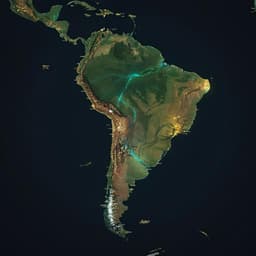
South America is becoming warmer, drier, and more flammable

Earth Sciences

South America is becoming warmer, drier, and more flammable

S. Feron, R. R. Cordero, et al.

Discover how climate patterns since 1971 have intensified fire risk across South America, particularly in regions like the northern Amazon and Gran Chaco. This eye-opening research by Sarah Feron, Raúl R. Cordero, Alessandro Damiani, and their colleagues highlights the alarming trends influenced by the El Niño-Southern Oscillation and human activities.... show more
Introduction

Climate extremes and extreme weather are major threats to humans and ecosystems. Dry extremes include warm temperatures, droughts, and enhanced fire weather, while wet extremes include pluvials, heavy precipitation, and floods. Climate change is worsening the frequency, intensity, and impacts of climate extremes, with intensities projected to double at 2 °C warming and quadruple at 3 °C relative to 1.5 °C.

Multiple extremes can occur simultaneously, forming compound extremes, which amplify environmental, economic, and health impacts through interacting physical and societal mechanisms. Hot and dry conditions driven by rising temperatures increase fire risk, and recent severe wildfire seasons globally have been favored by extreme fire weather (high temperatures, dryness, low humidity). In South America, warming and drying are more pronounced in some regions; heatwaves and droughts are surging, often linked to more frequent atmospheric blockings, leading to enhanced fire weather and catastrophic fire activity.

Large-scale climate modes, notably El Niño–Southern Oscillation (ENSO), strongly influence South American climate. Through teleconnections, ENSO modulates interannual variability of compound dry extremes: El Niño weakens trade winds and warms the eastern tropical Pacific, while La Niña strengthens trade winds and enhances upwelling. The study investigates how these modes modulate the occurrence of concurrent warm, dry, and flammable conditions across key South American regions since 1971, with special attention to regions undergoing major land-use change or substantial precipitation losses (Maracaibo, northern Amazon, and Gran Chaco).

Literature Review
Methodology

Study regions: Three South American regions were defined using raw latitude/longitude boxes without land cover maps: (1) Maracaibo region (6–12°N, 65–75°W), encompassing the Maracaibo basin and northern Venezuela; (2) Northern Amazon (3°N–8°S, 55–63°W), covering parts of Roraima, western Pará, and eastern Amazonas (Brazil); (3) Gran Chaco (13–31°S, 55–65°W), encompassing most of the Chaco basin, including Mato Grosso do Sul, southern Mato Grosso, and much of the Brazilian Pantanal.

Data: Daily surface weather from ERA5 reanalysis (2-m temperature, precipitation, relative humidity, wind required for FWI) for 1971–2022. Fire Weather Index (FWI) computed from daily noon wind speed, 24-h precipitation, temperature, and relative humidity following the Canadian FWI system. Weekly SST anomalies for Niño regions from NOAA CPC.

Definition of extremes and compounds: Following Sutanto et al. and Feron et al., daily binary maps were constructed for each grid cell: warm=1 if daily maximum temperature (TX) anomaly > 90th percentile; dry=1 if 30-day running mean precipitation (P) anomaly < 50th percentile; flammable=1 if daily FWI anomaly > 90th percentile, all relative to a 30-year base period (1971–2000). The base climatology for TX and FWI used a 15-day rolling window over the 30-year period to create 450-value distributions per calendar day; for P, a 30-day rolling window yielded 900 values per day. Anomalies were computed as departures from the daily base climatology. Rationale: TX and FWI require high thresholds (90th) due to acute impacts; precipitation deficits at the 50th percentile over 30-day periods can be consequential. Daily compound dry days were identified where warm, dry, and flammable flags co-occurred.

Temporal aggregation: Annual counts of warm, dry, flammable, and compound days were derived for 1971–2022. Seasonal analyses used standard meteorological seasons (DJF, MAM, JJA, SON). For region-focused fire seasons, counts were computed for ASO (Northern Amazon and Gran Chaco) and JFM (Maracaibo) to align with late dry-season wildfire peaks.

ENSO influence: Pearson correlations (p<0.05 significance) were computed between annual and seasonal counts of compound dry days and SST anomalies in Niño 1+2 (0–10°S, 90–80°W) and Niño 3.4 (5°N–5°S, 170–120°W) regions, using detrended series where applicable. Spatial correlation maps identify regions with significant associations.

Sensitivity: Authors note alternative 30-year reference periods (e.g., 1981–2010, 1991–2020) do not affect trend calculations or absolute rankings. Analyses and plots were produced using Python/Matplotlib.

Key Findings
  • Compound extremes surged: Days with concurrent warm, dry, and flammable conditions increased markedly in the northern Amazon, Maracaibo, and northeastern Gran Chaco.
  • Magnitude of increase: In regions like the northern Amazon, Maracaibo, and the Brazilian Pantanal (northeastern Gran Chaco), compound days rose from generally <20 days/year (1971–2000) to as high as ~70 days/year in recent decades. The decadal average of compound days increased threefold (1971–2022) in the northern Amazon and Maracaibo.
  • Component extremes: • Warm days increased by about 60 days/year in the Amazon and Maracaibo (2001–2022 vs. 1971–2000). • Dry days increased by >50 days/year in Gran Chaco and Maracaibo; annual precipitation declined by ~100 mm (Gran Chaco) and ~200 mm (Maracaibo), although totals remain >1000 mm/year. • Flammable days rose steeply; from <40 days/year (1971–2000) to up to ~120 days/year in the northern Amazon and Maracaibo in the last decade.
  • Spatial patterns: Increases were smaller in Ecuador and Patagonia; within Gran Chaco, the Brazilian Pantanal saw the largest rises in flammable and compound days. Eastern Brazil (e.g., Tocantins) had increases in flammable days but smaller compound increases than the northern Amazon due to lesser warming.
  • Seasonal patterns: • Maracaibo: increases throughout the year, slightly sharper in DJF. • Northern Amazon: steepest increases in JJA, coincident with higher temperatures and reduced precipitation. • Gran Chaco: strongest increases in JJA and SON; Pantanal shows pronounced spring (SON) increases linked to warmer temperatures and reduced precipitation.
  • Interannual variability: Multiple record-high compound seasons occurred in the 2000s–2020s (e.g., Gran Chaco: 2004, 2007, 2010, 2020; Northern Amazon: 2005, 2010, 2015, 2017, 2020; Maracaibo: 2003, 2010, 2016, 2020). The standard deviation of seasonal compound-day counts roughly doubled from 1971–2000 to 2013–2022 across all three regions.
  • ENSO modulation: • El Niño increases compound dry extremes in the northeastern/northern Amazon (record 2015 El Niño coincided with record compound days) and affects Maracaibo; correlations significant with Niño 1+2 and 3.4 SST anomalies depending on season. • La Niña enhances compound extremes in Gran Chaco (active fire seasons 2004, 2007, 2010, 2020 aligned with La Niña in Niño 1+2). Strong anticorrelation between compound days and Niño-region SSTs in Gran Chaco, especially in JJA. • Seasonally, correlations are strongest in DJF for northeastern Amazon and Maracaibo, and in JJA for Gran Chaco; Paraguay shows stronger links to Niño 1+2, eastern Bolivia to Niño 3.4 in JJA.
  • Trend attribution note: No significant long-term SST trend in Niño regions suggests ENSO likely modulates variability but is not the primary driver of the upward trend; anthropogenic warming likely drives the trend.
  • Fire activity: Satellite-observed fire activity mirrors fire weather interannually (e.g., 2020), but long-term trends are strongly influenced by policy and enforcement (e.g., Brazil’s post-2004 regulations).
Discussion

The study demonstrates that compound warm, dry, and high fire risk conditions have intensified across key South American regions since 1971, addressing the research question on progression and drivers of compound dry extremes. The results indicate anthropogenic warming as the predominant driver of the rising trend in compound extremes, with ENSO exerting strong modulation on interannual and seasonal variability: El Niño favors dry compounds in the northern Amazon and Maracaibo, while La Niña favors them in the Gran Chaco, consistent with known alterations to the Walker circulation and South American monsoon.

The significance lies in quantifying the magnitude and seasonality of increases in compound extremes and clarifying ENSO’s spatially and seasonally dependent footprint. These insights are highly relevant for risk management, land-use planning, and public health interventions, especially in regions undergoing rapid land-use change (e.g., Gran Chaco) or possessing critical ecological functions (Amazon). The findings also emphasize the role of non-climatic factors—policy, land management, ignition sources—in shaping actual fire activity, highlighting that reducing vulnerability requires both climate adaptation and governance actions.

Broader implications include feedbacks between dry compounds, fire activity, and the Amazon’s carbon–water cycle. Enhanced fires and black carbon emissions can reduce cloud formation and rainfall, increase atmospheric warming, darken Andean snowpack (lower albedo, faster melt), and stress forest water supply, risking Amazon resilience and potential dieback. The work underscores the urgency of region-specific assessments and responses focused on extremes, not just average climate changes.

Conclusion

This work provides a continent-scale, multi-decadal assessment of concurrent warm, dry, and flammable conditions in South America, showing substantial increases—up to threefold in compound days—in highly sensitive regions such as the northern Amazon and Maracaibo, and strong seasonal increases in Gran Chaco and the Pantanal. It demonstrates that ENSO modulates the interannual and seasonal variability of these extremes—El Niño enhancing risk in the northern Amazon/Maracaibo and La Niña in Gran Chaco—while anthropogenic warming likely drives the long-term trend.

Main contributions include: (i) a consistent, reanalysis-based framework to quantify compound dry extremes and their components; (ii) identification of hotspots and seasons with the largest increases; (iii) quantification of enhanced interannual variability; and (iv) mapping of ENSO teleconnections to compound dry conditions.

Future research directions: (1) formal attribution studies to disentangle anthropogenic forcing from natural variability; (2) integration of Atlantic SST influences (e.g., AMO, NTA) and other modes; (3) improved representation of land-use/land-cover change, fuel dynamics, and ignition sources; (4) high-resolution downscaling and impact modeling for sector-specific risk; (5) evaluation of health impacts and development of Heat/Health Warning Systems; and (6) assessment of governance and policy interventions on fire outcomes under increasing compound extremes.

Limitations
  • Attribution not performed: While ENSO modulation is characterized and anthropogenic warming is suggested as a driver, a formal detection and attribution analysis was beyond scope.
  • Data source constraints: Reliance on ERA5 reanalysis and derived FWI may introduce uncertainties inherent to reanalysis products and FWI parameterizations.
  • Threshold and window choices: Definitions (e.g., 90th percentile for TX and FWI anomalies; 50th percentile for 30-day precipitation anomalies) and rolling windows, though justified, may influence results; alternative definitions could yield quantitative differences.
  • Regional delineation: Regions were defined by latitude/longitude boxes without detailed land cover/change boundaries, which may include heterogeneous subregions and land-use mosaics.
  • ENSO correlations: Associations are based on Pearson correlations (p<0.05) and do not establish causality; analyses focus on Niño 1+2 and 3.4 and do not fully explore Atlantic or other basin influences within the same framework.
  • Fire activity vs. fire weather: Actual burned area and fire counts are influenced by human activities, policy, and fuel availability; thus, fire weather increases do not directly imply proportional increases in fire activity.
Listen, Learn & Level Up
Over 10,000 hours of research content in 25+ fields, available in 12+ languages.
No more digging through PDFs, just hit play and absorb the world's latest research in your language, on your time.
listen to research audio papers with researchbunny