logo
ResearchBunny Logo
Tunable CO₂ electroreduction to ethanol and ethylene with controllable interfacial wettability

Chemistry

Tunable CO₂ electroreduction to ethanol and ethylene with controllable interfacial wettability

Y. Lin, T. Wang, et al.

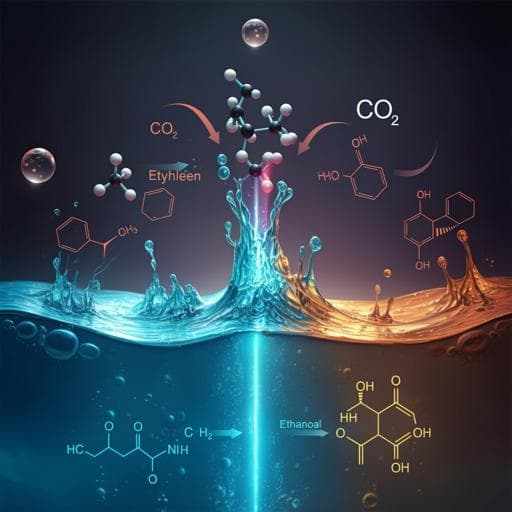
Discover how interfacial wettability can revolutionize CO₂ electroreduction pathways, producing both ethylene and ethanol efficiently. This groundbreaking research demonstrates control over the CO and H ratios, optimizing the production of multi-carbon products with impressive Faradaic efficiencies. Conducted by a team of experts including Yan Lin, Tuo Wang, and others, the findings pave the way for enhanced sustainable chemical processes.... show more
Introduction

Electrochemical CO₂ reduction (CO₂RR) to value-added multicarbon (C₂+) products offers a route to close the carbon cycle but suffers from poor selectivity. On Cu, which uniquely binds *CO favorably and *H weakly, many products form and selectivity depends critically on surface coverage of key intermediates *CO and *H. Prior studies emphasized high *CO coverage to promote ethylene, while higher *H coverage favors ethanol formation; however, the interplay and competition between *CO and *H governing ethylene versus ethanol pathways remains insufficiently understood. In gas-diffusion electrode (GDE) systems, despite shortened diffusion paths relative to H-cells, metallic catalysts are intrinsically hydrophilic and become covered by a thin electrolyte film, making gas diffusion through the catalyst layer limiting. Low CO₂ solubility in water depletes CO₂ in this film, altering the local CO₂/H₂O supply and thereby *CO/*H coverage and selectivity. Hydrophobic modifiers (organic molecules, polymers, ionomers) can improve reactant transport by inducing hydrophobic microenvironments, but continuous, precise control of wettability is challenging and the specific role of interfacial wettability in steering ethylene versus ethanol pathways is rarely clarified. Therefore, developing an approach to systematically tune local CO₂/H₂O availability—and thus kinetic-controlled *CO/*H ratios—by altering interfacial wettability is of great importance.

Literature Review

The study situates itself within efforts to tune CO₂RR selectivity on Cu via: (i) facet engineering and surface morphology control to modulate *CO adsorption and coverage; (ii) alloying and constructing metal/compound hybrids to adjust intermediate binding; and (iii) modifying catalyst microenvironments with hydrophobic organics, polymers (e.g., PTFE), and ionomers (e.g., Nafion) to alter local CO₂ and H₂O transport. While such strategies can raise C₂+ selectivity, they often preferentially affect *CO over *H, may inadvertently increase hydrophilicity or introduce CO/H₂ co-producing sites, and typically do not permit continuous wettability tuning. Moreover, GDE-based enhancements via hydrophobic layers improve performance but make it difficult to deconvolute the specific contribution of wettability to ethylene vs ethanol pathways. The literature underscores that local reactant transport and interfacial contact states (liquid-solid vs gas-liquid-solid vs gas-solid) strongly impact local CO₂/H₂O concentrations and hence *CO/*H coverage, but a systematic, tunable approach to probe and optimize this balance has been lacking.

Methodology
  • Catalyst preparation: Cu catalysts were deposited onto carbon paper gas diffusion layers (Sigracet 29BC) by DC magnetron sputtering (40 W, 1 Pa, Ar 20 sccm, 10 min). Wettability was tuned by forming self-assembled alkanethiol layers with different alkyl chain lengths on Cu: Cu-4C (1-butanethiol), Cu-7C (1-heptanethiol), Cu-12C (1-dodecanethiol), Cu-18C (1-octadecanethiol). After immersion in neat thiol under Ar (1 min for 4C/7C/12C; 10 min at 60 °C for 18C), samples were rinsed in ethyl acetate (5 min; 60 °C for 18C) and vacuum-dried (60 °C). A CuAg sample was prepared by sputtering Ag (10 W, 10 s) onto Cu.
  • Characterization: SEM and cross-sectional SEM to assess morphology and thickness; XRD to identify facets; TEM/EDX to visualize the 2–3 nm alkanethiol layer; ATR-SEIRAS to confirm thiol adsorption; XPS/AES to analyze Cu oxidation states and Cu–S bonding; contact angle measurements to quantify wettability (∼43°, 95°, 112°, 131°, 156° as chain length increases).
  • Electrochemical testing: CO₂RR in a three-compartment flow cell with AEM (FAA-3-PK-75), 1 M KOH in both chambers, Ni foam counter electrode, Hg/HgO reference, CO₂ feed 20 sccm, electrolyte flow 10 mL min⁻¹. Product analysis via online GC (CO, H₂) and HS-GC for liquids. Tests at -1.2 V vs RHE and across different current densities; no iR correction. CORR performed with CO/N₂ (10/20 sccm).
  • Stability and controls: 6.5 h chrono tests at -1.2 V vs RHE; post-reaction SEM, XRD, XPS, HRTEM, contact angle, OH electroadsorption to verify structural and wettability stability. ECSA via double-layer capacitance; BET on Cu powders with/without thiol; EIS at OCP to assess Rct, mass transport (Warburg), and double-layer capacitance.
  • Probing local environment and intermediates: CFD simulations to model gas/liquid distribution and CO₂/H₂O transport with varying contact angle, using a simplified porous catalyst island model. In-situ fluorescence electrochemical spectroscopy (HPTS probe) during chrono at 100 mA cm⁻² to infer local CO₂ concentration dynamics. In-situ ATR-SEIRAS to monitor *CO (linear CO band ~2070 cm⁻¹) coverage across potentials. CLSM with fluorescein-labeled KOH to visualize interfacial water distribution and quantify decay distance as a proxy for available water and thus *H. LSV for HER in 0.5 M H₂SO₄ and 1 M KOH to gauge H₂O transport effects independent of gas diffusion. In-situ Raman attempted for *H (not observed).
  • Theory: DFT (VASP, BEEF-vdW, PAW, 400 eV cutoff) on Cu(111)-(4×4) slabs with butyl mercaptan and 1-dodecanethiol to compare adsorption energetics of *CO and *H; adsorption free energies computed as ΔGads for *CO and *H. CFD equations included Navier-Stokes with surface tension terms; wettability varied via contact angle boundary conditions.
Key Findings
  • Wettability control: Alkanethiol chain length systematically increased water contact angle from ~43° (bare Cu) to 95°, 112°, 131° (Cu-12C), and 156° (Cu-18C), forming uniform ∼2–3 nm layers while preserving Cu(111) character.
  • CO₂RR selectivity and activity: As contact angle increased from 43° to 131°, C₂+ FE rose from 55.4% to 86.1%, with total current density increasing from 91.4 to 103.3 mA cm⁻² at -1.2 V vs RHE. At superhydrophobic 156°, C₂+ FE and partial current decreased. Across current densities, C₂+ FE remained high; notably, 80.3% C₂+ FE at 400 mA cm⁻² with a C₂+ partial current density of 321 mA cm⁻².
  • Ethanol vs ethylene tuning: Ethanol-to-ethylene ratio continuously tuned from 0.90 to 1.92 by wettability. Ethanol FE increased from 23.8% to 53.7% (peak near CA ~131°), then decreased at CA 156°. Under superhydrophobicity (156°), ethylene FE increased while ethanol was suppressed. Methane followed ethylene trends; propanol followed overall C₂+ trends. CO FE decreased from 26.1% to 2.7% and then increased to 8.9% with increasing hydrophobicity; H₂ FE dropped below 10% upon hydrophobic treatment.
  • Mechanistic probes: In-situ ATR-SEIRAS showed stronger and wider-potential-range linear CO (~2070 cm⁻¹) bands on hydrophobic Cu, indicating higher *CO coverage across -0.6 to -1.2 V. FES evidenced higher steady-state local CO₂ concentration and faster recovery on more hydrophobic interfaces, demonstrating enhanced CO₂ mass transport. CLSM revealed increasing decay distance with hydrophobicity, indicating reduced interfacial water availability (lower *H). HER LSVs showed hydrophilic Cu had the highest HER activity in both acidic and alkaline electrolytes, consistent with more efficient H₂O transport.
  • Modeling insights: CFD indicated hydrophilic surfaces form a continuous thin electrolyte film (gas must diffuse through liquid), whereas superhydrophobic surfaces present gas-solid interfaces (facilitating gas transport but hindering H₂O). Intermediate wettability (gas-liquid-solid three-phase contact) balances CO₂ and H₂O transport, optimizing the kinetic-controlled *CO/*H ratio for high C₂+ and ethanol selectivity.
  • Performance stability and structure: 6.5 h tests maintained current and selectivity; alkanethiol layer persisted, facet and morphology remained similar; ECSA decreased after hydrophobic modification consistent with reduced electrolyte contact; Rct and mass transport features from EIS reflected reduced wetting.
Discussion

The findings demonstrate that interfacial wettability governs local CO₂/H₂O supply, which kinetically controls surface *CO and *H coverages and thereby the branching between ethylene and ethanol pathways on Cu. Increasing hydrophobicity enhances CO₂ and CO access/retention at the catalyst, elevating *CO coverage, while simultaneously limiting interfacial water availability and *H coverage. An intermediate, balanced wettability (gas-liquid-solid interface) maximizes both C₂+ selectivity and ethanol yield by providing sufficient *H to hydrogenate C–C coupled intermediates while maintaining high *CO for C–C coupling. Pushing to superhydrophobicity shifts the reaction limitation from CO₂ deficiency to H deficiency, favoring ethylene over ethanol due to insufficient hydrogenation capacity. Spectroscopic (ATR-SEIRAS) and imaging (CLSM, FES) measurements, together with CFD, corroborate the proposed mechanism by linking wettability to local reactant concentrations and to proxies of *CO/*H coverage. Thus, tuning wettability offers a kinetic, microenvironment-focused lever that complements traditional active-site modifications for steering CO₂RR selectivity at high current densities.

Conclusion

This work introduces a direct interfacial modification strategy using alkanethiols of varying chain length to continuously tune catalyst wettability and thereby the kinetic-controlled *CO/*H balance in CO₂RR on Cu. The approach yields high and tunable C₂+ selectivity, including ethanol FE up to 53.7%, overall C₂+ FE up to 86.1%, and sustained 80.3% C₂+ FE at 400 mA cm⁻² with a 321 mA cm⁻² C₂+ partial current density. Mechanistic analyses (ATR-SEIRAS, FES, CLSM) and CFD modeling establish how wettability modulates local CO₂/H₂O transport, shifting the rate-limiting step from CO₂ supply to H supply as surfaces become more hydrophobic, which tunes ethanol versus ethylene formation. This kinetic microenvironment control provides a generalizable pathway to optimize gas–liquid–solid interfaces for selective multicarbon electrosynthesis. Future work should focus on engineering porous electrodes with moderate, stable hydrophobicity to further enhance activity, durability, and selectivity under industrially relevant conditions.

Limitations
  • Direct measurement of *H coverage on Cu was not achievable by in-situ Raman or ATR-SEIRAS due to weak adsorption; *H was inferred indirectly from interfacial water content (CLSM) and competitive site occupation with *CO.
  • Local CO₂ concentration within the catalyst layer could not be measured directly and was probed via an optical fluorescence proxy (HPTS) and supported by CFD, introducing modeling and calibration assumptions.
  • Extremely high hydrophobicity (CA ~156°) reduced water availability and decreased C₂+ and ethanol performance, indicating a trade-off and the need for precise wettability control.
  • Stability demonstrations were limited to ~6.5 h under the tested conditions; longer-term durability and resistance to flooding/drying in practical devices were not assessed.
  • Simplified CFD geometry (island-and-pore model) may not capture full complexity of porous electrodes; DFT models focused on Cu(111) with selected thiols and may not encompass all surface states present under reaction conditions.
Listen, Learn & Level Up
Over 10,000 hours of research content in 25+ fields, available in 12+ languages.
No more digging through PDFs, just hit play and absorb the world's latest research in your language, on your time.
listen to research audio papers with researchbunny