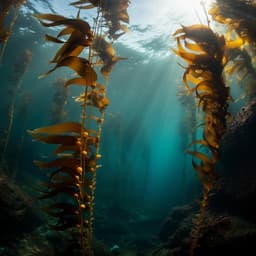
Earth Sciences
The Blob marine heatwave transforms California kelp forest ecosystems
K. M. Michaud, D. C. Reed, et al.
Marine heatwaves—acute periods of anomalously high ocean temperatures—are increasing in frequency and severity due to anthropogenic climate change and have caused extensive ecological and socioeconomic impacts in marine ecosystems. Beyond direct thermal stress on organisms, marine heatwaves can intensify ocean stratification, reduce upwelling of nutrient-rich waters, and depress phytoplankton production that underpins coastal food webs. Sessile suspension-feeding invertebrates in temperate kelp forests serve as a critical trophic link between pelagic production and the benthos but may be especially vulnerable to warming and reduced food supply due to their sedentary nature and constraints on foraging and reproduction. This study evaluates how communities of sessile invertebrates in southern California kelp forests responded to the 2014–2016 Northeast Pacific marine heatwave known as “The Blob,” asking whether warming-associated changes in temperature and phytoplankton availability altered invertebrate cover, richness, and community composition, and whether such changes persisted beyond the event.
Recent work documents increasing frequency and intensity of marine heatwaves under global warming and their severe impacts, including coral bleaching and losses in seagrass and kelp. Prolonged warming can reduce upwelling, lowering nutrient delivery and phytoplankton production essential to temperate coastal food webs and habitat-forming macroalgae. Foundation species such as giant kelp can show variable resistance and resilience across regions and warming events, with canopy losses often increasing understory algal cover and altering competitive dynamics for benthic space. Sessile invertebrates differ in life-history traits and feeding strategies; colonial taxa (e.g., many bryozoans, ascidians, sponges) are generally short-lived and fast-growing, while anthozoans and mollusks tend to be longer-lived and may tolerate low phytoplankton via alternative feeding strategies or lower metabolism. Invasive species can capitalize on disturbance and warming, sometimes outperforming native congeners under thermal or nutrient stress. Together, the literature suggests heatwaves can drive community reorganization, functional change, and potential regime shifts in temperate reefs.
Study system: Five subtidal rocky reef sites along the mainland of the Santa Barbara Channel (Southern California Bight) were monitored: Carpinteria (34.5°N, 119.5°W), Mohawk (34.7°N, 120.0°W), Vista (34.9°N, 120.4°W), Naples (34.3°N, 119.5°W), and Arroyo Quemado (34.4°N, 120.2°W). Sites (rocky shale/sandstone/mudstone) ranged from ~5–7.5 m depth and were seasonally monitored by the Santa Barbara Coastal LTER program.
Oceanographic anomalies: Bottom temperature was recorded with Onset loggers fixed to the seafloor, sampling every 15 min. Seasonal means were computed for 2003–2021 and anomalies calculated as seasonal means minus long-term seasonal means. Marine heatwave days were identified using the 90th percentile threshold for 2003–2021 and summarized by season and site. Surface chlorophyll-a was obtained from MODIS-Aqua mapped products; average values were extracted within 4-km squares centered 2 km offshore of each reef to avoid kelp canopy interference. Seasonal chlorophyll-a was computed from multi-month averages.
Benthic community sampling: Sessile invertebrates were surveyed seasonally from 2008–2013 and through the Blob period and beyond when possible. Divers sampled permanent 2 m × 2 m plots and along fixed-point percent-cover transects at set intervals. Taxa were identified to species where possible; encrusting/generalist categories were used when species-level identification was not feasible. Percent cover was estimated by point-contact methods. Species richness was calculated as the number of unique sessile invertebrate taxa per sampling period.
Statistical analyses: Piecewise structural equation models (SEM) were fit in R (v4.1.2) using the piecewiseSEM package to assess drivers of invertebrate percent cover and species richness. Predictors included seasonal temperature anomaly, chlorophyll-a, giant kelp (Macrocystis pyrifera) biomass, understory macroalgal cover, and purple urchin density; variables were transformed as needed (e.g., square-root for proportional cover and richness; log for chlorophyll-a and kelp biomass). Models were stratified by season and site. Community composition changes relative to the Blob (before, during, after) were tested using PERMANOVA on Bray–Curtis dissimilarities and visualized with Canonical Analysis of Principal Coordinates (CAP). Indicator Species Analysis identified taxa associated with time periods. Transformations (square-root) and standard community ecology procedures (Bray–Curtis) were applied; model selection considered AIC and significance thresholds are reported in the results.
- The Blob coincided with positive bottom temperature anomalies and negative chlorophyll-a anomalies across sites.
- Mean sessile invertebrate cover declined 71% during the Blob, reaching a 14-year minimum of ~7% in autumn 2015; species richness declined 69% over the same period.
- Temperature had strong negative effects on invertebrate cover (standardized coefficient −0.46), and the proportion of the community exhibiting negative responses to temperature increased to 95% during the Blob.
- Giant kelp biomass related positively to sessile invertebrate cover (0.40) and was reported alongside species richness (−0.46 as stated), implying kelp declines during future warming could worsen invertebrate losses.
- Understory algal cover was a strong negative predictor of invertebrate cover (−0.45) and species richness (−0.32), consistent with increased competition for space when kelp canopy is reduced.
- Phylum-level responses were uneven: bryozoans, anemones, and ascidians declined to their lowest cover during the Blob; bryozoans and anemones rebounded by ~2017, sponges recovered more slowly (not evident until ~2020). Mollusks were relatively unaffected during the heatwave and attained their highest cover in subsequent years.
- Despite many phyla returning to pre-Blob cover within a few years, species composition shifts persisted (PERMANOVA F = 13.462, p < 0.001). Cover and richness rose post-Blob, peaking in summers 2017–2018, driven largely by bryozoans and mollusks.
- Invasive bryozoans increased post-Blob: Watersipora subatra (IndVal = 0.455, p < 0.001) and Bugula neritina (IndVal = 0.549, p < 0.01) expanded, with B. neritina surpassing the native B. californica.
- A native southern-affinity gastropod, Thylacodes squamigerus, increased significantly after the Blob (IndVal = 0.711, p < 0.001), potentially reflecting thermal preadaptation and capacity to use kelp detritus as food.
- Community reorganization indicates lasting, climate-linked transformation of California kelp forest sessile invertebrate assemblages beyond the acute heatwave period.
Findings show that an acute marine heatwave can drive sharp declines in sessile invertebrate cover and richness via both direct thermal stress and indirect food limitation from depressed phytoplankton, with effects varying by phylum according to life-history and feeding traits. While giant kelp biomass in the Santa Barbara Channel was relatively resilient during the Blob, known warming-induced kelp declines elsewhere and the observed positive linkage between kelp and invertebrate assemblages imply that future heatwaves may compound impacts on suspension feeders. Increases in understory algae, often following kelp canopy loss, can further suppress sessile invertebrates through space competition. Post-Blob recoveries in total cover masked persistent changes in species composition, including expansion of invasive bryozoans and a warm-affinity native gastropod, signaling a climate-driven shift in community structure. Such taxonomic and functional turnover may alter benthic–pelagic coupling and food web dynamics if the post-heatwave ‘winners’ differ functionally from previously dominant taxa. Overall, the results underscore that marine heatwaves can catalyze lasting ecological transformations beyond immediate biomass losses, with implications for biodiversity, ecosystem functioning, and management of kelp forest systems as heatwaves intensify under climate change.
The study demonstrates that the 2014–2016 Blob marine heatwave precipitated steep declines in sessile invertebrate cover and richness in southern California kelp forests and initiated persistent shifts in community composition that have endured for years. Recovery in total cover post-Blob was driven largely by bryozoans (including invasive species) and mollusks, while sponges recovered slowly. The expansion of invasive bryozoans and a warm-affinity native gastropod suggests a climate-mediated reassembly of sessile invertebrate communities. Given projected increases in marine heatwave frequency and intensity, similar transformational changes are likely across temperate rocky reefs, potentially exacerbated by warming-related declines in kelp and shifts in understory macroalgae. Future research should quantify functional consequences of these compositional changes for benthic–pelagic coupling and food webs, disentangle direct thermal vs. indirect nutritional pathways, assess the role of recruitment bottlenecks under low phytoplankton, and evaluate management strategies to bolster kelp forest resilience.
- Geographic scope was limited to five reefs in the Santa Barbara Channel; results may not generalize across the broader California Current or other temperate systems with different oceanography and community structure.
- Observational design limits causal attribution among concurrent drivers (temperature, stratification, food supply) during the Blob.
- Temporal sampling intensity varied among years and seasons, and some methodological descriptions indicate gaps or changes in sampling frequency, which could influence fine-scale temporal inference.
- Proxies (e.g., satellite chlorophyll-a for food availability nearshore) and site-level biomass estimates may not capture all local variability relevant to sessile invertebrates.
- Some taxa were grouped to higher categories when species-level identification was not possible, potentially obscuring species-specific responses.
Related Publications
Explore these studies to deepen your understanding of the subject.