
Medicine and HealthNature Communications
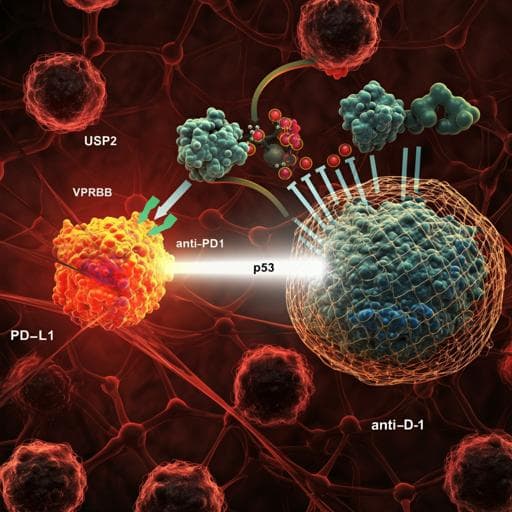
Targeting USP2 regulation of VPRBP-mediated degradation of p53 and PD-L1 for cancer therapy
J. Yi, O. Tavana, et al.
Exciting discoveries in cancer therapy show that targeting the USP2-VPRBP axis can effectively reactivate p53 and reduce toxicity compared to traditional Mdm2 inhibitors. This innovative approach, explored by authors Jingjie Yi, Omid Tavana, Huan Li, Donglai Wang, Richard J. Baer, and Wei Gu, demonstrates complete tumor regression in wild-type p53 tumors with the combination of a USP2 inhibitor and anti-PD1 antibody.
Related Publications
Explore these studies to deepen your understanding
Adjacent work that informs or extends this paper's methodology and findings.

Medicine and Health
Radiogenomics for predicting p53 status, PD-L1 expression, and prognosis with machine learning in pancreatic cancer
Y. Iwatate, I. Hoshino, et al.
Engineering and Technology
Nanoparticles and convergence of artificial intelligence for targeted drug delivery for cancer therapy: Current progress and challenges
R. P. Singh, A. Natarajan, et al.
Medicine and Health
CD317 maintains proteostasis and cell survival in response to proteasome inhibitors by targeting calnexin for RACK1-mediated autophagic degradation
J. Cheng, G. Zhang, et al.
Medicine and Health
A region-confined PROTAC nanoplatform for spatiotemporally tunable protein degradation and enhanced cancer therapy
J. Gao, X. Jiang, et al.


