Psychology
"Some hate it, others love it": Formation of automatic and reflective affective processes toward exercising in fitness centers and mountain biking
J. Limmeroth and C. Braun
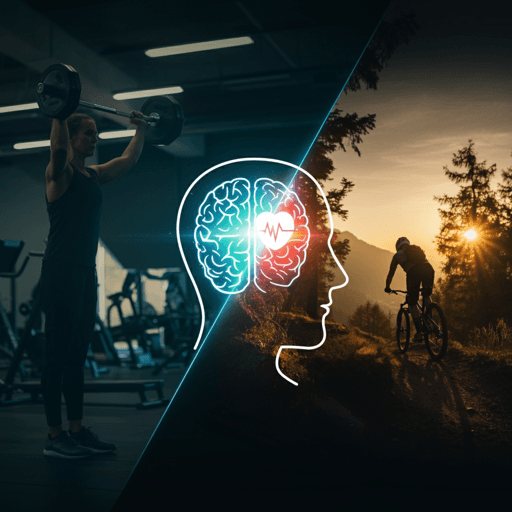
Many people do not meet WHO recommendations for physical activity, and affective experiences differ across exercise types and settings. Some individuals prefer gym-based activities (e.g., weightlifting, cardio), while others avoid fitness centers and favor outdoor activities like mountain biking. Affective experiences, both automatic and reflective, influence exercise decisions and adherence. Dual process perspectives suggest that automatic affective associations with exercise differ between exercisers and non-exercisers and may also vary by preferred exercise type and setting. This study investigates whether people who frequently exercise in specific settings (fitness centers vs. mountain biking) differ in their automatic and reflective affective processes toward those specific types of exercise. The research question asks if automatic affective processes are specific enough to distinguish preferences for particular exercise settings beyond general differences between exercisers and non-exercisers.
Dual process theories posit two interacting systems: automatic (type I) and reflective (type II) processes that guide behavior. The Affective-Reflective Theory (ART) of physical inactivity and exercise specifies that repeated affective experiences linked to exercise are stored as associations, which, when triggered by cues, elicit somato-affective reactions (“gut feelings”) that can drive approach or avoidance unless overridden by reflective processes given sufficient self-control. Prior evidence shows that exercisers tend to hold more positive automatic associations with exercise than non-exercisers, and that automatic processes correlate with activity amount/frequency. Less is known about specificity to exercise types or settings. Antoniewicz and Brand (2014) found that fitness-center exercisers had more positive automatic and reflective evaluations of fitness-related stimuli than active individuals preferring other settings, with non-significant correlations between automatic and reflective measures. Limmeroth and Hagemann (2020) showed runners with high activity levels had more positive automatic associations toward running than non-exercisers and less active non-runners, along with differences in reflective attitudes. These findings suggest both amount of exercise and preferred setting/type may shape automatic affective processes, motivating the present study’s focus on fitness centers vs. mountain biking.
Design: Quasi-experimental design with three groups: fitness center exercisers (FIT), mountain bikers (MTB), and people engaging in little or no exercise (L-NE). Participants completed a computer-based Evaluative Priming (EP) task to assess automatic affective processes toward specific exercise categories and an online questionnaire to assess reflective affective attitudes and recent exercise behavior. Participants: Recruited from fitness clubs, university sport, mountain biking courses, campus, medical fields, and public spaces. Inclusion for FIT/MTB: indicate the respective activity as preferred setting/type; perform that activity >90 min/week and total exercise >112.5 min/week (WHO vigorous activity guidance). Inclusion for L-NE: exercise <45 min/week. Initially 76 participated in EP; 8 did not complete the questionnaire; 3 were too active for L-NE; 4 had excessive EP errors (M=30.31%, SD=8.25); 1 was a statistical outlier in exercise amount. Final N=60; mean age 30.87 (SD=7.53); 33% women. Group descriptives (min/week; M [SD]): L-NE (n=23): exercising 23.86 [35.05], MTB 3.26 [11.04], fitness 9.89 [27.70]; FIT (n=21): exercising 448.39 [284.80], MTB 0 [0], fitness 336.19 [150.70]; MTB (n=16): exercising 311.64 [200.17], MTB 177.03 [121.75], fitness 48.75 [84.05]. Power analysis: Based on prior work, assumed large effect (d=0.80) for group differences in automatic affective processes toward fitness and mountain biking; power 0.80; alpha 0.05 (two-sided); G*Power indicated N=66 required. Measures:
- Evaluative Priming Task: Following Fazio et al. (1986) and Limmeroth & Hagemann (2020) without neutral targets. Prime pictures: 20 for each of three exercise categories (exercising in fitness centers; mountain biking; various types of exercise) and 20 control pictures (“work on computers”); each picture shown twice for 160 trials. Targets: positive and negative adjectives (4–6 letters) from BAWL-R with balanced valence (M_positive=1.98, SD=0.17; M_negative=-1.79, SD=0.17). Trial structure: fixation/blank and prime-target sequence with responses by keypress to classify target valence as quickly and accurately as possible. Trials >2000 ms or incorrect were omitted and randomly repeated; RTs <250 ms treated as outliers and removed. Response keys counterbalanced across participants. Apparatus: E-Prime 3.0 on a Fujitsu Lifebook E782 (15.6"; 1280×1024; 75 Hz). Task duration ≈15–20 min. Internal consistency (Cronbach’s alpha): αFIT=0.63; αMTB=0.59; αEXE=0.30. Priming effect calculation indexed as differential facilitation/inhibition relative to control primes for positive vs negative targets for each category.
- Questionnaires: Physical Activity and Exercise (BSA; German) to compute weekly exercise time, mountain biking time, and fitness activities time (Fuchs et al., 2015). Reflective affective attitudes (Brand, 2006) assessed for exercising in fitness centers, mountain biking, and exercise in general via four affective semantic differential items on 1–9 scales; adapted to each specific exercise type; mean score computed per scale. Procedure: Participants received study information, completed the EP task in a quiet room or on-site (fitness centers/university buildings), then completed the online questionnaire via QR/link. Ethics approval obtained; informed consent provided; procedures adhered to the Helsinki Declaration. Data analysis: Descriptive statistics (means, SDs). EP data prepared per recommendations: removal of extreme RTs/outliers and high-error participants (>20%). Reaction times in ms used to compute priming effects per category. One-way ANOVAs with Group (FIT, MTB, L-NE) as between-subjects factor on each priming score (automatic affective associations) and on each reflective affective attitude scale. Alpha p<0.05; effect sizes reported as Cohen’s d. Welch’s ANOVA applied where assumptions were violated. Analyses conducted in SPSS 27.
EP performance: Mean target identification RT=671.53 ms (SD=63.78); mean error rate 4.20% (SD=3.37). Positive targets responded to faster (M=628.18 ms, SD=56.49) than negative (M=706.68 ms, SD=73.36). Mean RTs similar across prime types; no overall RT differences between groups: F(2,57)=1.82, p=0.17, d=0.51 (FIT M=650.83 ms; MTB M=687.14 ms; L-NE M=679.58 ms). RTs and priming effects were normally distributed. Automatic affective processes (priming effects):
- Exercising in fitness centers: Significant group differences, F(2,57)=3.98, p=0.03, d=0.74. Means (M [SD]): FIT 23.17 [54.01]; MTB 13.02 [44.71]; L-NE -18.69 [54.13]. Bonferroni post hoc: FIT > L-NE (p=0.03); FIT vs MTB non-significant.
- Mountain biking: Non-significant, F(2,57)=1.24, p=0.30, d=0.42. Means: FIT 8.79 [45.10]; MTB 15.67 [48.10]; L-NE -9.62 [61.52].
- Various types of exercise: Non-significant, F(2,57)=0.92, p=0.40, d=0.36. Means: FIT -4.67 [57.69]; MTB 2.81 [54.29]; L-NE -21.30 [59.41]. Reflective affective processes (1–9 scales):
- Fitness centers: Welch’s F(2,28.66)=36.70, p<0.01, d=1.78; FIT scored higher than MTB (M difference=3.13, 95% CI [1.41, 4.85]) and L-NE (M difference=3.75, 95% CI [2.57, 4.94]); Games–Howell p<0.01. Descriptives: L-NE M=4.43 (SD=2.12), FIT M=8.29 (SD=0.88), MTB M=5.16 (SD=2.58).
- Mountain biking: Welch’s F(2,37.33)=58.16, p<0.01, d=2.73; MTB > FIT (M difference=4.03, 95% CI [2.87, 5.20]) and L-NE (M difference=4.53, 95% CI [3.26, 5.80]); Games–Howell p<0.01. Descriptives: L-NE M=3.46 (SD=2.18), FIT M=3.95 (SD=1.85), MTB M=7.98 (SD=1.00).
- Exercise in general: F(2,57)=25.46, p<0.01, d=1.89; L-NE lower than MTB (M difference=-2.43, 95% CI [-3.54, -1.31]) and FIT (M difference=-2.68, 95% CI [-3.72, -1.64]); Games–Howell p<0.01. Descriptives: L-NE M=5.37 (SD=1.76), FIT M=8.05 (SD=0.98), MTB M=7.80 (SD=1.09). Correlations (entire sample): Automatic fitness priming not significantly correlated with reflective fitness (r=0.14, p=0.27) or reflective mountain biking (r=0.12, p=0.35). Automatic exercise-in-general not correlated with reflective exercise-in-general (r=0.06, p=0.66). Automatic fitness priming correlated with reflective exercise-in-general (r=0.29, p=0.02).
Findings support that automatic affective processes can be specific to exercise settings: fitness center exercisers exhibited more positive automatic associations toward fitness center stimuli than those with little or no exercise, with a similar (but non-significant) advantage over mountain bikers of comparable activity levels. This suggests that both exercise amount and setting/type preference jointly contribute to the formation of automatic associations. For mountain biking, group differences in automatic associations were not significant, potentially due to heterogeneous and multifaceted affective representations: outdoor contexts often evoke positive affect, but mountain biking’s risk/adrenaline aspects can involve fear and high arousal, leading to mixed associations. Reflective affective attitudes clearly distinguished groups, aligning with their preferred exercise, indicating strong conscious affective evaluations for preferred activities and more positive views of exercise in general among active groups. The largely non-significant correlations between automatic and reflective measures are consistent with dual-process accounts and ART, which posit partially independent contributions of automatic and reflective systems to exercise behavior, with occasional linkage where contexts overlap (e.g., fitness contexts closely tied to the concept of exercising).
The study demonstrates that automatic affective processes can differentiate preferences for specific exercise settings, notably showing more positive automatic associations toward fitness centers among frequent gym exercisers. Reflective affective evaluations strongly align with individuals’ preferred exercise types. The results highlight the importance of using appropriately tailored stimulus sets and measurement techniques to capture setting- and type-specific automatic processes. Future research should test generalizability across additional exercise types and settings (e.g., treadmill vs outdoor running), compare different stimulus sets to probe underlying automatic processes, and examine moderators that alter the interplay between automatic and reflective processes (e.g., stress, self-control demands). Greater attention to in-situ affective responses during exercise may further clarify how affect shapes future participation.
- Relationship and conditions under which automatic and reflective processes correlate remain unclear; reflective processes may update faster than automatic ones, potentially causing inconsistencies.
- Reaction-time implicit measures require carefully matched, context-appropriate stimuli; ambiguity in stimuli (especially for outdoor/risk contexts like mountain biking) may yield heterogeneous associations.
- Evaluative Priming tasks have limited reliability on average; internal consistency varied by category here and was insufficient for the “various exercise” category.
- Small overall sample (N=60), with particularly small MTB group (n=16) and incomplete questionnaire responses among some participants, reducing power to detect differences.
- Findings depend on the specific stimuli and measures used; overgeneralization should be avoided.
Related Publications
Explore these studies to deepen your understanding of the subject.