logo
ResearchBunny Logo
"Some hate it, others love it": Formation of automatic and reflective affective processes toward exercising in fitness centers and mountain biking

Psychology

"Some hate it, others love it": Formation of automatic and reflective affective processes toward exercising in fitness centers and mountain biking

J. Limmeroth and C. Braun

Listen to findings from Julia Limmeroth and Claudia Braun: using a dual-process approach with N=60 and an Evaluative Priming task, the study found that automatic positive affect toward fitness-center exercise was strongest in regular gym-goers, automatic responses for mountain biking did not differ significantly between groups, and reflective affective measures differed by exercise habit for each activity.... show more
Abstract
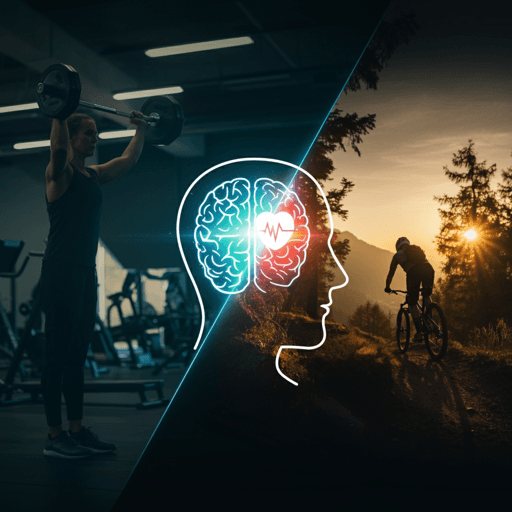
Based on a dual process approach, this study was conducted to test whether automatic affective processes toward exercise are not only interrelated with the amount of exercise but also distinctive for different types of exercise. In a quasi-experimental setting, N=60 participants (30.87 years ± 7.53; 33% female) completed an Evaluative Priming task to assess automatic affective processes toward exercising in fitness centers, mountain biking and exercise in general and completed a questionnaire about their exercise behavior and their reflective affective processes toward each type of exercise. The results showed that the automatic affective processes toward exercising in fitness centers differed significantly among the three groups (d=0.74). Those who regularly exercise in fitness centers (n=21) provided the most positive automatic affective processes, followed by mountain bikers (n=16) and those engaging in little or no exercise (n=23). Automatic affective processes toward mountain biking were nonsignificant between groups (p=0.30; d=0.42). All reflective affective processes assessed via questionnaire resulted in significant differences between the three groups, always in favor of those who often perform the respective exercise. Our results show that automatic affective processes toward exercising in fitness centers are distinctive for the preference for this type of exercise. Furthermore, they underline the importance of choosing an adequate measurement technique to assess automatic affective processes toward exercise, especially if these processes should be indicative for the preference of different types of exercise.
Publisher
German Journal of Exercise and Sport Research
Published On
Mar 18, 2022
Authors
Julia Limmeroth, Claudia Braun
Tags
dual process
automatic affective processes
evaluative priming
exercise preference
fitness centers
mountain biking
reflective affective processes
Listen, Learn & Level Up
Over 10,000 hours of research content in 25+ fields, available in 12+ languages.
No more digging through PDFs, just hit play and absorb the world's latest research in your language, on your time.
listen to research audio papers with researchbunny