
BiologyFrontiers in Human Neuroscience
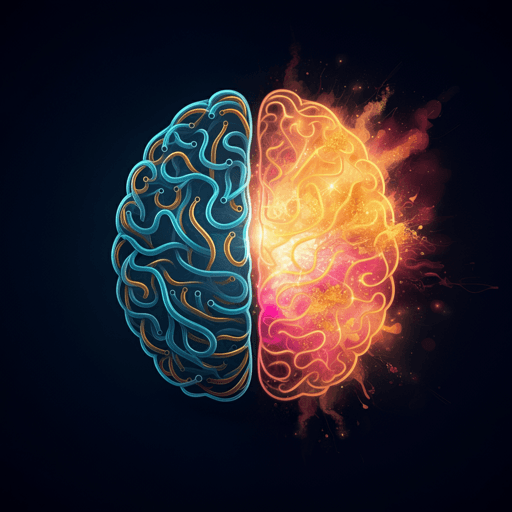
The neuronal basis of human creativity
R. Malach
Human creativity may arise from slow, spontaneous fluctuations in brain activity—resting state fluctuations—that integrate random neuronal noise with learned, deterministic information to generate original yet meaningful ideas. This research was conducted by Rafael Malach.
Related Publications
Explore these studies to deepen your understanding
Adjacent work that informs or extends this paper's methodology and findings.
Medicine and Health
Neuronal responses in the human primary motor cortex coincide with the subjective onset of movement intention in brain-machine interface-mediated actions
J. Noel, M. Bockbrader, et al.
Medicine and Health
Neuronal responses in the human primary motor cortex coincide with the subjective onset of movement intention in brain-machine interface-mediated actions
J. Noel, M. Bockbrader, et al.
Computer Science
The paradox of creativity in generative AI: high performance, human-like bias, and limited differential evaluation
J. Desdevises
Computer Science
The paradox of creativity in generative AI: high performance, human-like bias, and limited differential evaluation
J. Desdevises


