logo
Loading...
Semantic scope of Indus inscriptions comprising taxation, trade and craft licensing, commodity control and access control: archaeological and script-internal evidence

Humanities

Semantic scope of Indus inscriptions comprising taxation, trade and craft licensing, commodity control and access control: archaeological and script-internal evidence

B. A. Mukhopadhyay

Discover groundbreaking insights into the ancient Indus script inscriptions, revealing their role in taxation and trade control. Join Bahata Ansumali Mukhopadhyay as he unravels the complex use of seals and tablets in this fascinating study of a civilization's trade and regulatory practices.... show more
Introduction

The study addresses what the brief, undeciphered Indus script inscriptions signify and whether they record names or transactional details versus standardized administrative information. Context: At its peak (c. 2600–1900 BC), the Indus Civilization spanned ~1 million km² and has fewer than 6000 inscribed objects, mostly miniature seals, sealings, and tablets; inscriptions are short (average ~5 signs) and lack bilinguals. Purpose: Narrow the semantic scope of Indus inscriptions before assigning sign meanings, by combining script-internal structure with archaeological distribution. Hypothesis: Indus inscriptions, being semasiographic/logographic, primarily encoded administrative rules for taxation, trade/craft licensing, commodity control, and access control rather than proper nouns or individualized records.

Literature Review

The paper situates its argument amid a century of attempts to decode the Indus script. Prior influential approaches (e.g., Parpola, Mahadevan, Wells) have proposed logo-syllabic readings and anthroponym/toponym hypotheses, often inspired by Near Eastern/Egyptian practices where seals encode personal or place names. The author critiques these approaches as logically inconsistent with the Indus script’s brevity, wide geographic standardization, and semasiographic nature, noting difficulties such as limited corpus size, lack of bilinguals, uncertain underlying language(s), and poor chronological control. The work reviews sign-structural studies indicating formulaic segments (terminal PF1/PF2, pre-phrase-final PPF, core-informational, connectives, pre-connectives), and arguments that numerals and metrological signs show constrained, standardized usage unlike free transactional tallies. Comparative records from Egypt, Mesopotamia, and Seleucid Babylonia show that seals can encode institutional identities, tax types, and regulations rather than personal names, supporting a focus on administrative semantics. The paper also engages with views on iconographies representing organizational emblems (e.g., unicorn, bison) and debates on centralized versus heterarchical Indus governance, positioning its claims within broader discussions of Indus socio-economic organization.

Methodology

Data sources: Three primary corpora were analyzed—(i) the Interactive Corpus of Indus Texts (ICIT) (Wells & Fuls 2006/2023), (ii) Mahadevan’s digitized corpus (M77), and (iii) photographic corpora (CISI) by Joshi, Parpola, and colleagues. Where sign identifications differ, original artifact images (CISI and excavation reports) were consulted. Inscriptions are normalized right-to-left for analysis. Approach: Programmatic analysis of graphemic and combinatorial sign features across inscriptional segments (terminal PF1/PF2, PPF, core-informational, connectives, pre-connectives), coupled with contextual archaeological evaluation (find spots, association with weights, gateways, craft areas, storage structures). The study maps usage constraints of numerical/metrological signs, cross-compares seal, sealing, and tablet inscriptions (including obverse/reverse patterns for two-sided tablets), and examines geographic distribution and repetition of identical inscriptions across sites to infer standardized administrative functions.

Key Findings
  • Indus inscriptions are semasiographic/logographic and formulaic, not logo-syllabic; they do not encode proper nouns (anthroponyms, toponyms, or organization names). Arguments include: predictable positional sign classes (PF1, PF2, PPF, NUM, MET, CON, PC, Crop-Livestock, ENC) and semantic co-occurrence restrictions inconsistent with personal names; increasing inscription length over time mainly by adding core-informational units; sequences with numerals preceding commodity-like signs are widespread and standardized rather than person-specific.
  • Iconographies (e.g., unicorn, bison, rhinoceros, wild ass) likely functioned as emblems of guilds/authorities rather than textual encodings of names; seals with the same iconography carry varied inscriptions, and similar inscriptions occur with different iconographies across regions.
  • Numerical signs function as standardized quantifiers tied to specific signs rather than free counts. Only limited stroke-numerals precede selected sematograms (e.g., three short strokes ||| regularly before phytomorphic signs). Stroke-numerals on pottery likely denote capacities; semicircular numerals on metal tools may mark alloy/price/weight qualities.
  • Metrological jar-like signs (rimless V and rimmed variants) appear as quantifiers/connectives and are often modified by infixed numerals. The rimless-jar sign V occurs in >570 inscription lines (ICIT), with >90% on tablet reverse sides, typically preceded by 2, 3, 4, or 6 long strokes.
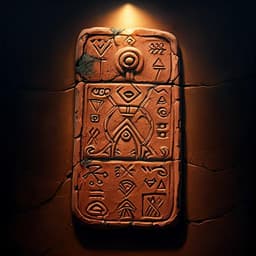
  • Two-sided tablets: Obverse inscriptions mirror seal-like content (commodity/craft-related permissions/regulations). Reverse sides exhibit highly constrained numerical-metrological expressions, chiefly V with two/three/four/six strokes (with two/three/four accounting for ~99% instances; the six-stroke form appears on only two tablets, H-801 and H-1881). This pattern is interpreted as license-fees/slabs rather than transaction quantities. Around 600 tablets have a single inscribed face; >800 tablets have two to four inscribed faces.
  • Reverse-side constructs (e.g., V with fixed stroke counts) are rare on seals (seals need not carry license slabs), whereas seals more often carry metrological jar signs modified with infixed numerals tied to taxes/tithes.
  • Commodity sealings (notably from Lothal) bear inscriptions that also appear on distant seals and tablets. The same inscription is impressed on varied containers (wooden boxes, leather sacks, pottery of different sizes) and on closure systems of rooms/storage, confirming they did not denote specific quantities or container capacities. Fingernail tallies on some box sealings function as counts of enclosed items, while the inscription’s numeral element likely denotes tax rate/licensing information.
  • Identical or near-identical inscriptions occur across distant Indus settlements, indicating standardized, system-wide regulations rather than local names or ad hoc texts.
  • Strong spatial and temporal correlations between inscribed seals and standardized weights (often co-located in rooms at similar depths) support use in taxation and regulated trade; weights (based on ratti seed standards) and seals both disappear after the urban decline, mirroring the Mesopotamian “Bala” tax tablets’ disappearance with state dissolution.
  • Seals concentrate near gateways and craft areas and appear in public administrative buildings (e.g., Mohenjo-daro DK-G South Blocks 6A and 8A), corroborating roles in customs-type taxation, excise control, and governance. Sealings are attached to container closures and storage structures, ensuring integrity and compliance (Functionality-6), and encoding commodity/rule information (Functionalities 4 and 5).
  • Access control: Kanmer round baked-clay pendants with identical seal impressions and handwritten reverse marks (including a site-specific wild ass sign) are interpreted as identity cards/passports (gate passes) linked to occupation-specific access.
  • Quantitative sign-class observations: PF1 signs appear in >2500 inscription lines; PPF signs in <500 inscriptions; connectives form complex and simple composite inscriptions; core-informational segments often contain multiple related signs; ENC signs function terminally and can stand alone as complete messages.
  • Religious usage is not primary: inscribed objects rarely occur in graves; narrative iconographic pieces may have secondary amuletic roles, but dominant contexts are commercial/administrative.
Discussion

The findings collectively support the central hypothesis that Indus inscriptions functioned as formalized administrative instruments rather than phonetic texts of names or detailed transaction records. Script-internal structure (fixed segments and sign-class roles), constrained numerical-metrological patterns, and cross-medium repetition (seals, sealings, tablets) align with standardized regulations (taxes, licenses, commodity categorizations) and access control. Archaeological context—association with city gates, workshops, standardized weights, storage/locking systems, and public administrative buildings—provides independent corroboration. The distribution of identical inscriptions across distant settlements implies inter-site coordination and harmonized rules, consistent with guilds/authorities collaborating during the Integration Phase to standardize trade/craft controls. Iconographies serve as organizational emblems, enabling recognition across linguistic regions without requiring phonetic encoding. The rarity of inscribed artifacts in religious contexts and their disappearance alongside standardized weights after urban decline further emphasize their administrative character. Overall, the study narrows the semantic scope of Indus texts to a domain conducive to future decipherment efforts focused on administrative semantics (tax-rate fractions, license slabs, commodity classes, institutional roles).

Conclusion

The article advances two main propositions: (i) Indus seals operated as revenue/tax stamps that encoded taxed commodities, licensed crafts, and fixed tax/tithe rates; (ii) Indus tablets functioned as licenses/permits issued to tax collectors, traders, and artisans—obverse sides specifying licensed activities (seal-like messages), reverse sides recording standardized license-fee/slab notations (e.g., V with 2/3/4/6 strokes). It rejects interpretations that Indus inscriptions primarily recorded anthroponyms/toponyms or transactional quantities. It further argues that iconographies—rather than texts—encoded issuer emblems (guilds/authorities), facilitating system-wide standardization without phonetic writing. Future research should: refine sign-class semantics within the narrowed administrative domain; quantify regional/temporal variation in license/tax-slab notations; test equivalency hypotheses between metrological signs and specific fee/measure systems; and expand contextual analyses as new sealings and stratified finds emerge.

Limitations
  • Corpus constraints: fewer than 6000 inscribed objects; inscriptions are brief (average ~5 signs), with few long texts; lack of bilinguals; uncertain underlying language(s) and relation to later scripts; incomplete chronological control in corpora.
  • Contextual gaps: relatively few preserved sealings; many sites partially excavated; some distributional inferences may shift with new finds; certain reverse-side impressions and container reconstructions are inferential.
  • Analytical scope: programmatic sign-class analyses rely on existing corpora (ICIT, M77, CISI) with occasional sign identification discrepancies; counts for sign-class occurrences are approximate; some tablets and seals may have multifunctional uses not fully recoverable archaeologically.
  • Interpretive caution: proposed mappings (e.g., numerals to tax-rate/license-slab schemes, metrological jar signs to standardized measures/fees) are hypothesis-driven, albeit supported by converging script-internal and archaeological evidence; definitive decipherment remains pending.
Listen, Learn & Level Up
Over 10,000 hours of research content in 25+ fields, available in 12+ languages.
No more digging through PDFs, just hit play and absorb the world's latest research in your language, on your time.
listen to research audio papers with researchbunny