logo
Loading...
Multimodal host-guest complexation for efficient and stable perovskite photovoltaics

Chemistry

Multimodal host-guest complexation for efficient and stable perovskite photovoltaics

H. Zhang, F. T. Eickemeyer, et al.

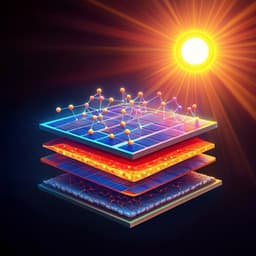
This research by Hong Zhang, Felix Thomas Eickemeyer, and colleagues introduces a novel multimodal host-guest complexation strategy utilizing dibenzo-21-crown-7 to enhance the stability and performance of formamidinium lead iodide perovskites in solar cells. The study demonstrates that this approach leads to power conversion efficiencies exceeding 24% and significant operational stability, illustrating the potential of host-guest chemistry in advancing photovoltaics.... show more
Introduction

Perovskite solar cells (PSCs) have achieved high power conversion efficiencies (PCE) with low-cost fabrication potential, but their operational stability under ambient conditions remains poor, and the presence of toxic lead raises environmental concerns. Device performance is further limited by surface and bulk defects that enhance non-radiative recombination. Formamidinium lead iodide (FAPbI3) and FAPbI3-rich perovskites offer superior optoelectronic properties and thermal stability, yet the desired photoactive black phase (α, 3C) readily transforms to wider-bandgap hexagonal polytypes (e.g., β, 2H) under ambient conditions, with β being thermodynamically favored at room temperature. Prior stabilization using alkali cations can help but homogeneous bulk incorporation increases the bandgap, complicates high-quality film formation, and does not address lead’s environmental impact. Here, the authors introduce a multimodal host-guest complexation strategy that simultaneously modulates surface and bulk composition via a synergistic effect of a crown ether host (dibenzo-21-crown-7, DB21C7), Cs⁺ guest, and their complex. Exploiting crown ether ion selectivity and solubility in orthogonal non-polar solvents (e.g., chlorobenzene), the CsI-DB21C7 complex is delivered to perovskite films without damage, creating a nanoscale gradient of Cs⁺ doping. This gradient assists charge separation, passivates defects, and stabilizes the perovskite phase while the crown ether also binds undercoordinated Pb, mitigating environmental impact. The approach targets improved efficiency and stability without compromising optimal optoelectronic properties.

Literature Review
Methodology

Perovskite film fabrication and treatment: FAPbI3 and (FAPbI3)0.97(MAPbBr3)0.03 films were deposited on FTO/c-TiO2/mp-TiO2 substrates via one-step spin-coating with antisolvent quench, followed by annealing (150 °C 10 min, then 100 °C 10 min). After annealing, films were treated by spin-coating a chlorobenzene solution of the CsI–dibenzo-21-crown-7 (DB21C7) complex (100 µL; optimized 8 mg/mL), left on the surface for 2 s, spun at 4000 rpm for 30 s, and thermally annealed at 100 °C for 5 min to promote Cs⁺ infusion, forming a gradient-doped layer. Films were then washed five times with chlorobenzene to remove excess species. Control samples were undoped, homogeneously Cs-doped, or crown-ether-only treated. Device architecture: FTO/c-TiO2 (~60 nm)/mesoporous Li-TiO2:perovskite composite (~150 nm)/perovskite upper layer (~650 nm)/spiro-OMeTAD (~150 nm)/Au (~70 nm). Spiro-OMeTAD doping used LiTFSI, 4-tert-butylpyridine, and FK209. Photovoltaic measurements: J–V under calibrated AM1.5G-equivalent Xe lamp, scan rate 50 mV/s, device area 0.25 cm2 masked to 0.16 cm2; EQE measured commercially; MPP tracking for stabilized PCE and stability. Stability: Shelf-life in ambient air (60±10% RH, 25±1 °C) and operational stability by unencapsulated MPP tracking under continuous illumination at ~100 mW cm−2 with N2 flow at 25 °C. Structural and surface characterization: XPS (PHI VersaProbe II; C 1s at 284.8 eV referencing; depth profiling to estimate Cs diffusion length ~484 ± 49 nm), UPS (He-I 21.22 eV) for work function and VBM; ATR-FTIR for C–O shifts; SEM and EDX/EDS (Zeiss Merlin) for morphology and elemental mapping; STEM-EDX (Thermo Fisher Tecnai Osiris) for cross-sectional composition; KPFM for surface potential; GIWAXS at PETRA III P08 (18 keV, variable incidence) and pXRD (PANalytical) to probe phases and surface species; XRR for surface layer thickness (~15 nm). Spectroscopy and device physics: Time-resolved photoluminescence (TRPL) with kinetic modeling for recombination constants; absolute PL in integrating sphere to determine PLQY and quasi-Fermi level splitting (ΔEF); cathodoluminescence mapping. NMR: Solid-state 133Cs and 14N NMR (21.1 T, MAS) to identify Cs incorporation and FA cation environment; liquid 1H NMR to verify complexation. Lead leakage: ICP-OES after immersing device pieces in DI water. Computation: DFT (Quantum ESPRESSO) with PBE/PBEsol and dispersion corrections; supercells and slabs to study Cs distribution models (M1–M3), polytype stabilization with Cs, defect passivation (FA⁺ vacancy), DOS and bandgap with PBE0+SOC; CPMD for gas-phase complexation energies of DB21C7 with Cs⁺, FA⁺, and Pb²⁺; simulated XRD of CsI-DB21C7 crystal based on literature structures.

Key Findings
  • Multimodal host–guest complexation using DB21C7 delivers Cs⁺ into FAPbI3 perovskites from a non-polar solvent, creating a nanoscale gradient of Cs doping while leaving crown ether assemblies at the surface. - XPS confirms Cs presence (Cs 3d3/2 at 739.0 eV, 3d5/2 at 725.0 eV) and elimination of metallic Pb peaks upon treatment, indicating binding/passivation of undercoordinated Pb by the crown ether. - UPS/KPFM show modified surface electronic structure: work function decreases from 4.14 to 3.83 eV (−0.31 eV), and VBM shifts from 1.45 to 1.71 eV at the surface, with more homogeneous surface potential. - SEM/EDS reveal larger grains, fewer grain boundaries, and needle-like surface structures containing Cs and C, attributed to CsI–DB21C7 assemblies. - GIWAXS/pXRD show reduced surface PbI2 and new low-q peaks (q ≈ 0.5 Å−1) consistent with CsI–DB21C7 surface crystals; XRR indicates ~15 nm surface layer; evidence for Cs-rich surface and gradient incorporation (unit cell smaller near surface; depth-dependent GIWAXS; XPS/TOF-SIMS). - ssNMR confirms Cs incorporation: 133Cs resonance at 8 ppm for thin film (~6 at% Cs) and 15 ppm for bulk-mixed sample (~12 at% Cs). 14N FWHM increases (to 48 kHz thin film; 76 kHz bulk) indicating cavity distortion consistent with Cs insertion. - DFT: Inhomogeneous Cs distributions (M1, M2) maintain bandgap near pristine (1.28–1.31 eV vs 1.32 eV) while creating Cs-rich wider-gap regions favorable for charge extraction; homogeneous distribution (M3) increases bandgap due to octahedral tilting. Cs reduces stability of 4H polytype, stabilizing α-FAPbI3 at Cs-rich surfaces. Cs passivates FA⁺-vacancy-induced trap states, delocalizing band-edge states. - Photovoltaic performance (FAPbI3-rich): Average metrics improved—Voc from 1.08 ± 0.01 V to 1.17 ± 0.01 V; FF from 75.7 ± 0.9% to 79.7 ± 0.9%; PCE from 20.56 ± 0.21% to 23.62 ± 0.43%. Champion target device: Voc 1.17 V, Jsc 25.50 mA cm−2, FF 81.9%, PCE 24.30% (stabilized 23.9% MPP); control PCE 21.20% (stabilized 20.5%). - TRPL indicates reduced monomolecular recombination (k1 from 2.3×10^5 s−1 to 1.4×10^5 s−1). ΔEF increases from 1.09 to 1.17 eV, matching Voc improvement; nonradiative Voc losses decrease (from 20.2% to 12.6%); transport losses decrease (from 10.7% to 5.2%). - Stability: Shelf-life dramatically improved—treated films stable >1 year (380 days) in air (60±10% RH, 25 °C) vs control degraded in 5 days. Unencapsulated operational stability: maintain >95% initial performance for 500 h under continuous MPP illumination. - Environmental aspect: Crown ether likely binds Pb²⁺ (computed complexation energy −8.93 eV) and reduces metallic Pb formation, potentially mitigating lead leakage impact.
Discussion

The host–guest complexation approach addresses the dual challenge of stabilizing α-FAPbI3 and reducing non-radiative recombination without widening the bulk bandgap. DB21C7 enables Cs⁺ delivery from an orthogonal solvent, forming a Cs-rich surface and a gradient of Cs incorporation into the bulk. This gradient preserves the bulk electronic structure while creating a wider-gap interfacial region that facilitates charge separation and suppresses interface recombination, as evidenced by UPS/KPFM and DFT-projected DOS. Experimentally, defect density and non-radiative recombination are reduced (TRPL, ΔEF, diode analysis), yielding higher Voc and FF and outperforming homogeneous Cs doping. Structural analyses (GIWAXS, XPS, NMR) confirm reduced PbI2, elimination of metallic Pb signatures, and Cs incorporation consistent with gradient profiles. The crown ether remains at the surface, passivating undercoordinated Pb and grain boundaries, further reducing interfacial barriers and improving transport. The combined surface modulation and bulk gradient doping synergistically enhance efficiency and stability, while the host’s Pb binding suggests reduced environmental risk. The approach generalizes to other alkali cations (e.g., Rb⁺) for interfacial passivation, although bulk incorporation depends on ion size/chemistry.

Conclusion

This work demonstrates a supramolecular, multimodal host–guest complexation strategy using DB21C7 to deliver Cs⁺ into FAPbI3 perovskites, establishing a beneficial gradient doping profile and surface passivation. The method preserves favorable bulk optoelectronic properties, suppresses non-radiative recombination, and stabilizes the α phase, enabling PCEs >24% and robust operational and shelf stability. The crown ether also binds Pb²⁺, addressing environmental concerns. The concept is broadly applicable to other ions and perovskite compositions, offering a versatile route to simultaneously engineer surface and bulk properties. Future work could optimize host structures for selective binding and delivery of various cations, explore other non-polar solvents and processing conditions, investigate tandem architectures, and quantify long-term lead mitigation and device encapsulation strategies.

Limitations
  • No dedicated exploration of perovskite formulations with excess A-site cations; results focus on FAPbI3 and FAPbI3-rich compositions. - Rb⁺ example indicates limited bulk incorporation; benefits may be ion-specific. - DFT models employ periodic supercells at 0 K with simplified distributions; finite-temperature dynamics and full compositional complexity may differ from experiments. - Surface species assignment (CsI–DB21C7) inferred from GIWAXS/pXRD and simulated patterns; exact polymorph distributions remain unresolved. - Environmental impact reduction is suggested via Pb²⁺ binding and reduced metallic Pb signatures; comprehensive lead leakage quantification beyond ICP-OES immersion tests is limited. - Device stability tests were conducted on unencapsulated cells under controlled conditions; real-world encapsulated performance and long-term outdoor stability remain to be validated.
Listen, Learn & Level Up
Over 10,000 hours of research content in 25+ fields, available in 22+ languages.
No more digging through PDFs, just hit play and absorb the world's latest research in your language, on your time.
listen to research audio papers with researchbunny