logo
ResearchBunny Logo
Mobile EEG for the study of cognitive-motor interference during swimming?

Psychology

Mobile EEG for the study of cognitive-motor interference during swimming?

M. Klapprott and S. Debener

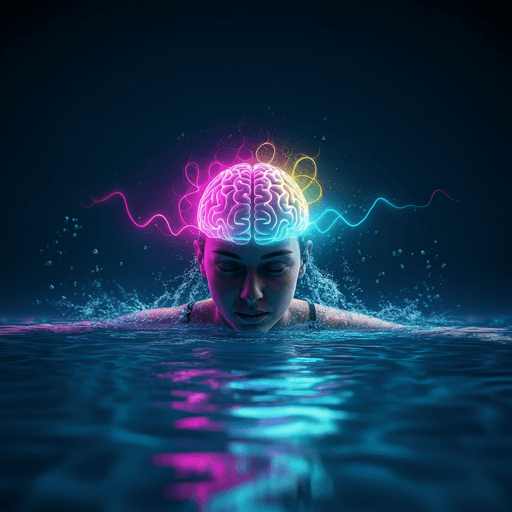
Can we record brain activity while people swim? This study demonstrates mobile EEG can function in an aquatic, freely moving task: the auditory N100 was reliably recorded across conditions, and exploratory time–frequency analyses revealed alpha/mu and beta modulations around turns, while P300 changes were not consistent. This research was conducted by Melanie Klapprott and Stefan Debener.... show more
Abstract
Research on brain function in natural environments has become a new interest in cognitive science. In this study, we aim to advance mobile electroencephalography (EEG) participant and device mobility. We investigated the feasibility of measuring human brain activity using mobile EEG during a full-body motion task as swimming, by the example of cognitive-motor interference (CMI). Eleven participants were given an auditory oddball task while sitting and swimming, with mobile EEG recording ongoing brain activity. Measures of interest were event-related potentials (ERPs) elicited by experimental stimuli. While the auditory N100 was measured to verify signal quality, the P300 to task-relevant stimuli served as a marker of CMI effects. Analyzes were first performed within subjects, while binomial tests assessed the proportion of significant effects. Event-related changes in the time-frequency domain around turns during swimming were analyzed in an exploratory fashion. The successful recording of the N100 in all conditions shows that the setup was functional throughout the experiment. Regarding CMI, we did not find reliable changes in P300 amplitude in different motor settings in all subjects. However, we found plausible modulations in the alpha/mu and beta bands before and after turns. This study shows that it is generally feasible to measure mobile EEG in the time and time-frequency domain in an aquatic environment while subjects are freely moving. We see promising potential in the use of mobile EEG in extreme settings, advancing toward the application of mobile EEG in more real-life situations.
Publisher
Frontiers in Human Neuroscience
Published On
Aug 29, 2024
Authors
Melanie Klapprott, Stefan Debener
Tags
mobile EEG
aquatic EEG
cognitive-motor interference
event-related potentials (N100, P300)
time-frequency analysis
alpha/mu and beta bands
full-body motion recording
Listen, Learn & Level Up
Over 10,000 hours of research content in 25+ fields, available in 12+ languages.
No more digging through PDFs, just hit play and absorb the world's latest research in your language, on your time.
listen to research audio papers with researchbunny