logo
ResearchBunny Logo
Influence of Social Identity and Personality Traits in Human–Robot Interactions

Computer Science

Influence of Social Identity and Personality Traits in Human–Robot Interactions

M. Staffa, L. D'errico, et al.

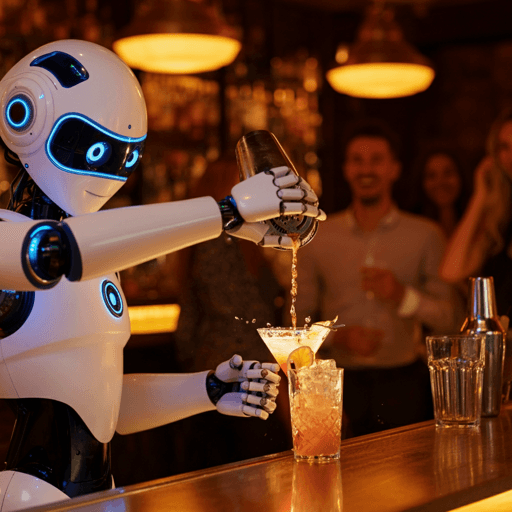
This study shows that a humanoid robot bartender can convey distinct social identities—positive or negative—and that patrons can perceive these personalities. With 28 participants and measures including the Big-5 and Godspeed questionnaires, the findings suggest tailoring a robot’s identity to users’ emotional states and traits can improve interactions. Research by Mariacarla Staffa, Lorenzo D'Errico, and Antonio Maratea.... show more
Introduction

The paper investigates whether a robot endowed with a distinct social identity—operationalized via contrasting personalities (positive vs. negative)—is perceived differently by users and whether such perceptions are modulated by users’ personality traits. Grounded in Social Identity Theory (SIT) and the CASA paradigm, the authors argue that human-like social identities can improve trust, empathy, and acceptance in HRI. Two research questions guide the work: RQ1 examines if users can perceive different robot identities; RQ2 examines whether relationships exist between robot identity and users’ Big-5 personality traits. The study situates itself within prior work on personalization and adaptive behavior in social robots, extending it by explicitly modeling robot social identity (physical, social, psychological dimensions) with a focus on the psychological/personality component in a bar interaction scenario.

Literature Review

The authors synthesize research on social and assistive robotics emphasizing personalization, empathy, theory of mind, adaptive behavior, and nonverbal cues. SIT (Tajfel & Turner) and CASA suggest humans ascribe social categories and human-like traits (e.g., gender, dominance, expertise) to machines, influencing interaction outcomes. Prior HRI work shows that social cues (gaze, proxemics), conversational design (voice pitch, humor, empathy), and persona influence engagement, likability, and perceived competence. Identity factors such as age identity are noted to shape interpersonal dynamics, motivating exploration of personality identity in robots. The paper identifies a gap: limited systematic investigation of how a robot’s distinct social identity (especially personality) affects HRI perceptions beyond general personalization, motivating the current within-subject bartender scenario.

Methodology

Design: Dual-condition within-participants study comparing a robot bartender with two social identities: positive (playful, friendly) vs negative (grumpy, disinterested). Order randomized (counterbalanced across the two possible orders). Participants: 28 volunteers (mostly Computer Science students; mean age ~25, two >50; 25% female). Ethics: informed consent; data anonymized. Measures: Big Five Inventory (BFI; 5-point Likert) for personality traits; Godspeed Questionnaire Series (GQS) for perceptions—anthropomorphism, likability, perceived intelligence, perceived safety. Apparatus/Robot: Interaction with a virtual Furhat bartender via laptop. Robot identity encoded via facial expressions (inspired by Ekman’s neurocultural theory) and dialog/register differences; for positive identity, added joking module and supportive prompts; for negative identity, curt prompts and early termination after repeated non-responses. Both identities included an age-check module for alcoholic orders. Procedure: 1) Information sheet and BFI. 2) First interaction with randomly assigned identity; place orders via on-screen buttons or voice; robot queried age for alcohol; users could continue or end. 3) Godspeed questionnaire. 4) Second interaction with the alternate identity. 5) Godspeed questionnaire again. Total session ~30 minutes per Figure 2 timeline. Statistical analysis: Paired-samples t-tests on GQS item scores to compare identities (Bonferroni-adjusted alpha = 0.002). Pearson correlations between Big-5 traits and GQS items computed separately for each identity; significance tested with Bonferroni correction (0.05/28). Exploratory Factor Analysis (EFA; R-factor analysis using correlation matrices with rotations) conducted to identify latent factors across GQS, and then jointly with Big-5, and to compare loading differences between identities.

Key Findings
  • Descriptive GQS results: Positive identity scored higher across likability items (e.g., dislike-like mean 3.9 vs 2.9; unfriendly-friendly 4.2 vs 2.1; unkind-kind 4.2 vs 2.3; unpleasant-pleasant 4.1 vs 2.6; awful-nice 4.1 vs 2.8). Perceived intelligence showed modest advantages for positive identity (e.g., incompetent-competent 3.7 vs 2.8; foolish-sensible 3.8 vs 2.8). Perceived safety showed higher relaxed feelings with positive identity (anxious-relaxed 4.0 vs 3.2) and slightly more surprise for negative identity (still-surprised 3.8 vs 3.4). Anthropomorphism differences were small across identities.
  • Paired t-tests (Bonferroni-adjusted alpha=0.002): Significant differences favoring positive identity on all likability items: dislike-like p=0.0017; unfriendly-friendly p<0.00001; unkind-kind p<0.00001; unpleasant-pleasant p=0.0001; awful-nice p=0.00002. For perceived intelligence, only foolish-sensible reached significance (p=0.0001). No anthropomorphism items were significant; other intelligence items were not significant after correction.
  • Pearson correlations: Patterns suggested for positive identity that extraversion and openness correlated with competence-related perceptions, and openness with kindness; for negative identity, neuroticism correlated with pleasantness/niceness. However, none survived Bonferroni correction (a=0.05/28); more data needed.
  • Factor analysis: Three robust latent factors emerged—(1) “Likability index” loading strongly on all likability and several competence items; (2) “Credibility factor” mirroring anthropomorphism items (fake-natural, machine-like–human-like, artificial–lifelike, movement elegance); (3) “Discomfort index” reflecting perceived safety (calm–agitated, still–surprised vs anxious–relaxed with opposite sign). Identity-specific EFA indicated perceptual shifts: in the negative identity, naturalness/human-likeness aligned more with competence; in the positive identity, these aligned with likability; extraversion became prominent within the competence factor under positive identity. Loading differences highlighted meaningful re-weighting across identities (e.g., movement elegance, naturalness, responsibility, and safety items).
Discussion

Findings confirm RQ1: participants reliably perceived distinct robot identities, with clear, significant increases in likability—and some competence-related perception—when the robot displayed a positive persona, despite similar anthropomorphism ratings across identities. This indicates that social identity expressed through behavior and affective cues can strongly modulate users’ socio-emotional appraisals without necessarily altering perceived human-likeness. Regarding RQ2, trends suggested interactions between users’ personality traits and their perceptions (e.g., openness and extraversion with competence under positive identity and neuroticism with pleasantness under negative identity), but correlations did not survive multiple-comparisons correction, likely due to limited power. Nonetheless, EFA showed identity-dependent restructurings of how users integrate cues (e.g., naturalness mapping to likability vs competence depending on identity), suggesting that user traits and context influence how social identity cues are integrated. Overall, programming distinct, consistent social identities in robots enhances user likability, comfort, and some facets of perceived competence, supporting the design of socially coherent personas. These results underscore the potential benefits of tailoring robot identity/interaction style to user dispositions to foster improved acceptance and predictability in HRI.

Conclusion

The study demonstrates that a robot’s programmed social identity—operationalized as positive vs negative personality—substantially affects user perceptions, particularly likability and certain competence-related judgments, while anthropomorphism remains relatively stable. This supports the feasibility and value of embedding coherent social identities into robots to improve interactions. Preliminary evidence suggests user personality may modulate these perceptions, advocating for personalization strategies that align robot identity with user traits. Future work should: (1) expand participant diversity and sample size to increase power and generalizability; (2) test additional contexts (e.g., eldercare, children with impairments) and longer-term interactions; (3) jointly manipulate physical appearance and identity to study their interplay; (4) explore a broader spectrum of identity/personality combinations and track how perceptions evolve over time; and (5) develop concrete research plans for identity synthesis and adaptation across prolonged HRI.

Limitations
  • Small sample size (n=28), limiting statistical power; no personality–perception correlations survived Bonferroni correction.
  • Convenience sample skewed toward Computer Science students, with gender imbalance (25% female), potentially limiting generalizability.
  • Use of a virtual Furhat interface via laptop; results may differ with a physical robot embodiment.
  • Focused on behavioral identity while controlling visual design; the influence of appearance was not varied in this study.
  • Within-subject design mitigates but does not eliminate potential order or carryover effects; only two identity conditions were tested.
Listen, Learn & Level Up
Over 10,000 hours of research content in 25+ fields, available in 12+ languages.
No more digging through PDFs, just hit play and absorb the world's latest research in your language, on your time.
listen to research audio papers with researchbunny