Engineering and Technology
Electrically driven reprogrammable phase-change metasurface reaching 80% efficiency
S. Abdollahramezani, O. Hemmatyar, et al.
The study addresses the need for fully integrable, highly efficient, and fast reconfigurable metasurfaces that overcome limitations of existing tunable platforms (e.g., weak modulation, high loss, low speed, and challenging fabrication). Optical metasurfaces can transform wavefronts but require post-fabrication tunability for adaptive functions. Conventional tunable materials (transparent conductive oxides, liquid crystals, 2D materials, doped semiconductors, elastomers) are limited by material losses, speed, or integration challenges. Phase-change materials (PCMs), particularly Ge2Sb2Te5 (GST), offer large refractive index contrast, non-volatility, nanosecond-scale switching, high endurance, CMOS compatibility, and low energy per switch, making them promising for dynamic metaoptics. Prior dynamic phase-change metasurfaces often relied on bulk heating or laser excitation, which are impractical for integrated operation and may only allow one-way switching. Electrical threshold switching via crossbar arrays introduces optical losses and non-uniform crystallization filaments. The authors propose an in situ electrically driven heterostructure: a robust, decoupled microheater delivers uniform Joule heating to a thin GST layer within a plasmonic metasurface, enabling multilevel, reversible, and efficient optical modulation with high modal overlap and reduced power. The research goal is to realize and characterize an electrically programmable, non-volatile, multistate phase-change metasurface with high optical efficiency, large dynamic range, fast speed, and integrable architecture, including beam steering via a phase-gradient design.
The paper situates its contribution within tunable metasurfaces employing materials such as transparent conductive oxides, liquid crystals, 2D materials, doped semiconductors, and elastomers, which suffer from trade-offs in modulation strength, loss, speed, and CMOS compatibility. PCMs (notably GST) are highlighted for non-volatility, ultrafast switching, high endurance, and large index change rooted in metavalent bonding. Earlier phase-change metasurfaces used thermal annealing or laser excitation to toggle phases, limiting reversibility or requiring bulky equipment. Electrical programming approaches inspired by phase-change memories face constraints from lossy electrode integration interfering with free-space optics and filamentary crystallization leading to non-uniform switching. Recent electrically reconfigurable metasurfaces with alternative alloys (e.g., GSST) improved losses but at the cost of slower intermediate-state registration and thicker films, complicating reliable amorphization. The present work advances beyond reflector-absorber PCM switches by achieving up to 80% optical efficiency, multilevel control, and large spectral tunability with a thin GST layer, uniform microheater-driven switching, and preserved optical performance across cycles.
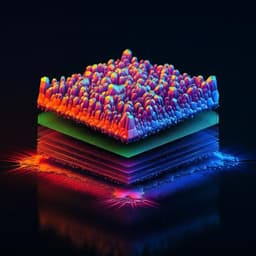
Device architecture: A heterostructure metasurface integrated with a resistive microheater. The microheater is a 12 µm × 12 µm, 50 nm-thick tungsten (W) square connected to Au probing pads, fabricated atop a Si substrate coated with 100 nm HfO₂ (thermal isolation). The heater is separated from the metasurface by a 20 nm Al₂O₃ layer (thermal coupling). The metasurface stack comprises an optically thick Au backreflector (80 nm), GST film (40 nm), encapsulated by Al₂O₃ (10 nm below and 10 nm above), and a 2D array of Au nanodisks (35 nm thick). An ultrathin Ti adhesion layer is used for Au. Periodicity and disk diameters vary per design (e.g., p = 600–620 nm; disk diameters tailored for modes). Fabrication uses ALD for HfO₂/Al₂O₃, RF sputtering for W and GST, and e-beam lithography with lift-off for patterning the heater and nanodisks.
Electrical programming: Two pulse schemes applied to the heater pads. Set (crystallization): double-exponential pulse of 200 µs duration, peak ~1.7 V, heating A-GST above ~160 °C for sufficient time to crystallize. Partial crystallization achieved by lowering voltage to access intermediate states. Reset (amorphization): rectangular 200 ns pulse with fast ~5–10 ns edges, peak ~3.4–3.8 V, melting (~630 °C) followed by rapid quenching to amorphize. For the meta-deflector, full crystallization used a 10.5 V, 200 µs pulse.
Electrothermal simulations: COMSOL Multiphysics coupled Electric Currents and Heat Transfer in Solids modules model Joule heating, temperature distributions, and transients, including convective boundaries and infinite elements. Material parameters from measurements/literature. Simulations indicate <12% in-plane temperature non-uniformity across the metasurface at the end of set pulses and <0.2% out-of-plane gradient; reset peak temperature ~790 °C with cooling rates ~10 °C/ns down to <480 °C and ~6 °C/ns thereafter, enabling amorphization.
Electromagnetic simulations and theory: Full-wave FEM (COMSOL) verified by CST; periodic boundary conditions in-plane and PMLs out-of-plane. Broadband normal incidence excitation; reflection amplitude and phase monitored. Optical constants of Al₂O₃ and GST from ellipsometry; Au from Palik. Modal picture: lower-wavelength long-range SPP (LR-SPP) governed by Bragg coupling (dispersion following k(λ) ± iG = K_LR-SPP), and higher-wavelength short-range SPP (SR-SPP) modeled as a Fabry–Pérot-like resonance along the disk with d_Au ≈ m λ_SR-SPP/(2 n_eff). Crystallization of GST tunes mode positions, linewidths, and overlap.
Optical measurements: Near-IR reflectometry with a fiber-coupled source, 50× NA 0.42 objective (∼8 µm spot), beam splitter to collect reflection, normalized to a nearby Au reference. In situ electrical pulses applied via probe while measuring reflectance spectra and back-focal-plane images (Fourier plane) for beam steering characterization.
Material characterization: Spectroscopic ellipsometry (1000–2000 nm, incidence angles 50°, 60°, 70°) modeled with Tauc-Lorentz/Cody-Lorentz to extract complex n,k for A-GST and C-GST, accounting for ∼5% thickness shrinkage upon crystallization and measured surface roughness. Raman spectroscopy confirms amorphous (broad peak) versus crystalline (dual-band) GST after electrical cycling. XPS and XRD used to verify composition and crystalline phase.
Machine learning analysis: Unsupervised t-SNE embedding of 3600 simulated reflectance spectra (1370–1640 nm) over randomized structural parameters to visualize clustering by GST phase (A vs C). Wrapper feature selection ranks parameter importance for modulation depth at 1550 nm (10% BW), identifying GST thickness, disk diameter, period, and Al₂O₃ thickness as most influential.
- Electrically driven, non-volatile, reversible tuning of a GST-based metasurface achieving up to 80% optical efficiency and an eleven-fold change in reflectance; absolute reflectance contrast reaching 80%.
- Quasi-continuous spectral tuning exceeding 250 nm in the near-IR by accessing multiple intermediate crystallization states via controlled set pulse amplitudes.
- Electrothermal performance: uniform heating (<12% in-plane temperature variation; <0.2% through-thickness), fast cooling rates (~10 °C/ns then ~6 °C/ns) enabling reliable amorphization after a 200 ns, ~3.4–3.8 V reset pulse; full crystallization with a 200 µs, ~1.7 V set pulse.
- Robust cycling: Over 50 consecutive set/reset cycles show stable binary operation; reflectance confidence intervals ±1% (reflective state) and ±7.5% (absorptive state) at the representative wavelength.
- Raman spectroscopy confirms reversible structural transitions between A-GST (broad Raman peak) and C-GST (dual-band Raman features) across cycles.
- Modal control: Electrical programming tunes LR-SPP and SR-SPP resonances; field profiles show energy funneling into GST at λ1 ≈ 1407 nm (SR-SPP) and strong dipolar resonance under the disk at λ2 ≈ 1600 nm (LR-SPP-like behavior for 80% crystalline state).
- Beam steering: A phase-gradient meta-deflector (supercells of 7 meta-atoms with tailored Au disk diameters, p ≈ 620 nm) steers the reflected beam to +20° (A-GST) and 0° (C-GST) at λ ≈ 1495 nm; measured/simulated far-field patterns corroborate anomalous-to-specular switching with a switching contrast ratio ≈ 10.8 dB and ∼30 nm operational bandwidth around 1495 nm.
- Machine learning maps reveal distinct clusters for A-GST and C-GST responses, indicating phase as an effective tuning knob; feature selection ranks GST thickness as the most impactful parameter for modulation depth, followed by Au disk diameter, period, and Al₂O₃ thickness.
- Potential switching speed of a few kHz inferred from thermal transients and pulse durations.
The results demonstrate that decoupling a robust microheater from the optical metasurface enables uniform, filament-free electrothermal phase transitions in GST without introducing optical losses from electrodes into the aperture. This architecture preserves strong modal overlap between the metasurface resonances (LR-SPP and SR-SPP) and an ultrathin, high-index-contrast PCM layer, producing large amplitude and spectral modulation with high efficiency. Using thin GST facilitates reliable amorphization via rapid quenching, allowing repeatable access to multiple intermediate crystallization levels that enable quasi-continuous tuning. Compared with prior laser- or bulk-annealed phase-change metasurfaces, the electrically driven approach is fully integrable, compact, and supports pixel-level programmability. The beam-steering meta-deflector validates dynamic phase control: programming GST switches the supercell phase gradient on and off, toggling between anomalous and specular reflection with useful contrast and bandwidth in the near-IR S band. The data-driven analysis confirms that the GST phase state expands the attainable response space and identifies key design sensitivities, guiding robust fabrication and optimization. Collectively, these findings address the core objectives of efficiency, dynamic range, speed, and integrability, advancing active metaoptics toward practical beam forming and adaptive photonics.
The work presents a chip-scale, electrically programmable GST-based metasurface platform that achieves unprecedented performance among phase-change metasurfaces: up to 80% optical efficiency, eleven-fold reflectance modulation, >250 nm quasi-continuous tuning, and prospective kHz-class switching. A decoupled W microheater ensures uniform, fast, and reversible phase transitions in an ultrathin GST layer integrated with a plasmonic metasurface supporting LR-SPP and SR-SPP modes. The platform also enables dynamic beam steering via a phase-gradient meta-deflector that switches between anomalous and specular reflection. Unsupervised and feature-selection machine learning analyses visualize the enlarged response space due to GST phase and rank critical design parameters (notably GST thickness) for modulation performance. Future directions include scaling to larger apertures, optimizing meta-atom geometries (e.g., free-form designs) to enhance diffraction efficiency and reduce amplitude variation across supercells, extending functionalities (varifocal lenses, spatial light modulators), and leveraging precision PCM growth (e.g., ALD) for uniform thin films and improved reliability in large-scale programmable metaoptics.
- Beam steering in the amorphous state exhibits non-uniform reflectance across the supercell and noticeable 0th-order leakage under normal incidence, indicating room for improved phase coverage with flatter amplitude response and higher diffraction efficiency.
- Reported switching speed is inferred as potentially a few kHz based on thermal dynamics; explicit high-speed experimental demonstrations are not provided.
- Small discrepancies between simulations and experiments are noted due to uncertainties in material thermal properties, parasitic resistances of contacts/pads, heater resistance variations, and thermal boundary resistances.
- The demonstrated metasurface aperture is limited (e.g., 100 µm × 100 µm for the deflector); scaling to larger areas may require additional thermal uniformity and fabrication controls.
- The Department of Electrical Engineering affiliation is listed without the full institution name in some places, reflecting minor reporting inconsistencies but not affecting technical results.
Related Publications
Explore these studies to deepen your understanding of the subject.