logo
ResearchBunny Logo
Cyberostracism: Effects of Being Ignored Over the Internet

Psychology

Cyberostracism: Effects of Being Ignored Over the Internet

K. D. Williams, C. K. T. Cheung, et al.
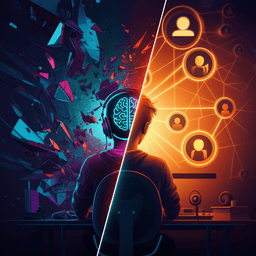
This groundbreaking research by Kipling D. Williams, Christopher K. T. Cheung, and Wilma Choi delves into the effects of cyberostracism—how being ignored online influences our emotions and behaviors. Through two substantial studies, the authors reveal that those excluded tend to feel worse and are more likely to conform. Understand the power of social connections in the digital age!

00:00
00:00
~3 min • Beginner • English
Abstract
Ostracism is such a widely used and powerful tactic that the authors tested whether people would be affected by it even under remote and artificial circumstances. In Study 1, 1,486 participants from 62 countries accessed the authors’ on-line experiment on the Internet. They were asked to use mental visualization while playing a virtual tossing game with two others (who were actually computer generated and controlled). Despite the minimal nature of their experience, the more participants were ostracized, the more they reported feeling bad, having less control, and losing a sense of belonging. In Study 2, ostracized participants were more likely to conform on a subsequent task. The results are discussed in terms of supporting K. D. Williams’s (1997) need threat theory of ostracism.
Publisher
American Psychologist
Published On
May 10, 2000
Authors
Kipling D. Williams, Christopher K. T. Cheung, Wilma Choi
Tags
cyberostracism
online exclusion
social belonging
conformity
need threat theory
psychological effects
virtual interactions
Listen, Learn & Level Up
Over 10,000 hours of research content in 25+ fields, available in 12+ languages.
No more digging through PDFs, just hit play and absorb the world's latest research in your language, on your time.
listen to research audio papers with researchbunny