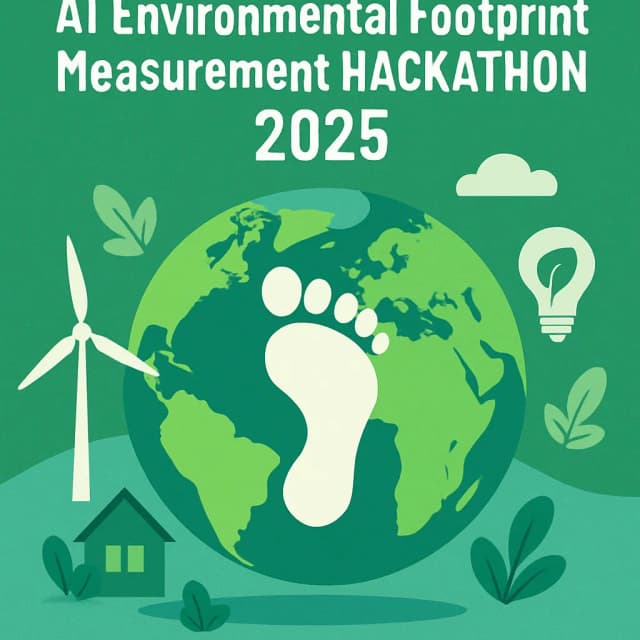
Al Environmental Footprint Measurement Hackathon 2025
📜 About the Hackathon
Artificial intelligence (AI) systems, including large language models (LLMs), are driving innovation across industries. However, their growing computational demands contribute significantly to carbon emissions and water usage, particularly in data centers. As AI adoption scales, there is an urgent need to develop reliable, transparent, and actionable methods to measure the carbon and water footprint of these systems.
This competition aims to bring together innovators from around the world to create proof-of-concept solutions that can accurately measure, monitor, and report the environmental impact of AI systems. By advancing the science of AI sustainability, stakeholders can make informed decisions and develop more efficient, eco-friendly AI technologies.
🎯 Focus Areas
Solutions should address one or more of the following areas:
- Carbon footprint measurement: Tools to calculate the carbon emissions generated by AI training and inference processes, including metrics for energy sources, computational intensity, and geographical variations.
- Water footprint monitoring: Systems to quantify the water usage required for cooling data centers and AI infrastructure.
- Real-time monitoring solutions: AI or IoT-based platforms for real-time tracking of energy and water consumption in data centers.
- Optimization insights: Solutions that not only measure but also provide actionable recommendations to reduce carbon and water footprints.
- Lifecycle assessment: Comprehensive methods to evaluate the environmental impact of AI systems across their lifecycle, from development to deployment and disposal.
🏆 Benefits
Prizes
- The winner gets an opportunity to present their solution at COP30 in Belem, Brazil.
✅ Eligibility Criteria
- Open to innovators, developers, researchers, students, climate advocates, and technology enthusiasts from around the world.
- Applicants can register as individuals or as teams.
- Interdisciplinary groups are encouraged—bring together expertise in AI, climate science, data engineering, and sustainability.
📊 Evaluation Criteria
Your solutions will be assessed based on the following:
- Innovation: Novelty and uniqueness of the solution.
- Accuracy: Precision and reliability in measuring carbon and water footprints.
- Feasibility: Practicality and scalability of the solution.
- Impact: Potential to drive transparency and sustainability in AI development.
- Presentation: Clear communication of findings and methodologies.
- Usability: Ease of use and intuitive design for stakeholders.
📅 Application Timeline and Process
Registration and Orientation: 1–27 August 2025
- Participants register individually or as teams.
- A detailed briefing on the competition goals, key concepts, and environmental metrics will be provided.
Proposal Submission: 29 August 2025
- Teams submit a concept note outlining their proposed solution, including its methodology, expected outcomes, and alignment with sustainability principles.
Proof-of-Concept Development: 1–30 September 2025
- Shortlisted teams will develop and demonstrate prototypes or proof-of-concept models over a designated period.
- Teams will have access to mentorship and resources from experts in AI, environmental science, and sustainability.
Final Presentation: 15 October 2025
- Teams present their solutions to a panel of judges comprising experts from AI, environmental science, and industry.
📌 Application Deadline
27 August 2025
🌐 Application Portal
- View details of the AI Environmental Footprint Measurement Hackathon.
- Apply for the hackathon via the registration form.
🤝 Sponsor Organisation
- International Telecommunication Union (ITU)
- The winner gets an opportunity to present the solution at COP30 in Belem, Brazil.