
How to Read Research Papers Faster - The Audio-First Approach That Works
Struggling to keep pace with an ever-growing reading list? ResearchBunny's AI audio briefs let you assess and absorb research papers in a fraction of the time, so you can cover more ground without sacrificing comprehension.




Trusted by Universities and Researchers across the world






Your Reading List Grows Faster Than You Can Clear It
A typical PhD student encounters 200-400 potentially relevant papers per year, yet realistically has time to read only a fraction closely. The standard advice - skim the abstract, jump to figures, read the conclusion - still demands 15-20 minutes per paper and leaves huge gaps in understanding. The backlog compounds, the anxiety builds, and important work gets missed.
Replace Slow Skimming with Fast, Structured Audio Triage
ResearchBunny reframes the question entirely: instead of reading faster, you listen smarter. A 3-minute audio brief surfaces the core contribution and findings of any paper, letting you decide in under five minutes whether the work deserves a deep read. For papers that do, the 6 or 9-minute options provide layered detail - all while commuting, exercising, or doing chores. Ask Bunny then handles follow-up questions so you never have to crack the PDF just to clarify one point.
Smarter Research, Done in Minutes
Everything you need to stay on top of research - without reading every word.
Triage 10 Papers in the Time You'd Read One
Three-minute audio briefs let you rapidly assess relevance and quality across your entire reading list before committing reading time to any single paper.
Reclaim Dead Time in Your Schedule
Listen during commutes, workouts, or meal breaks - ResearchBunny turns previously unproductive hours into consistent, high-quality literature review time.
Structured Comprehension, Not Just Speed
Unlike skimming strategies, audio briefs follow a consistent hypothesis-method-findings-implications structure that builds durable understanding rather than surface familiarity.
How It Works How ResearchBunny Helps You Triage and Absorb Papers at Speed
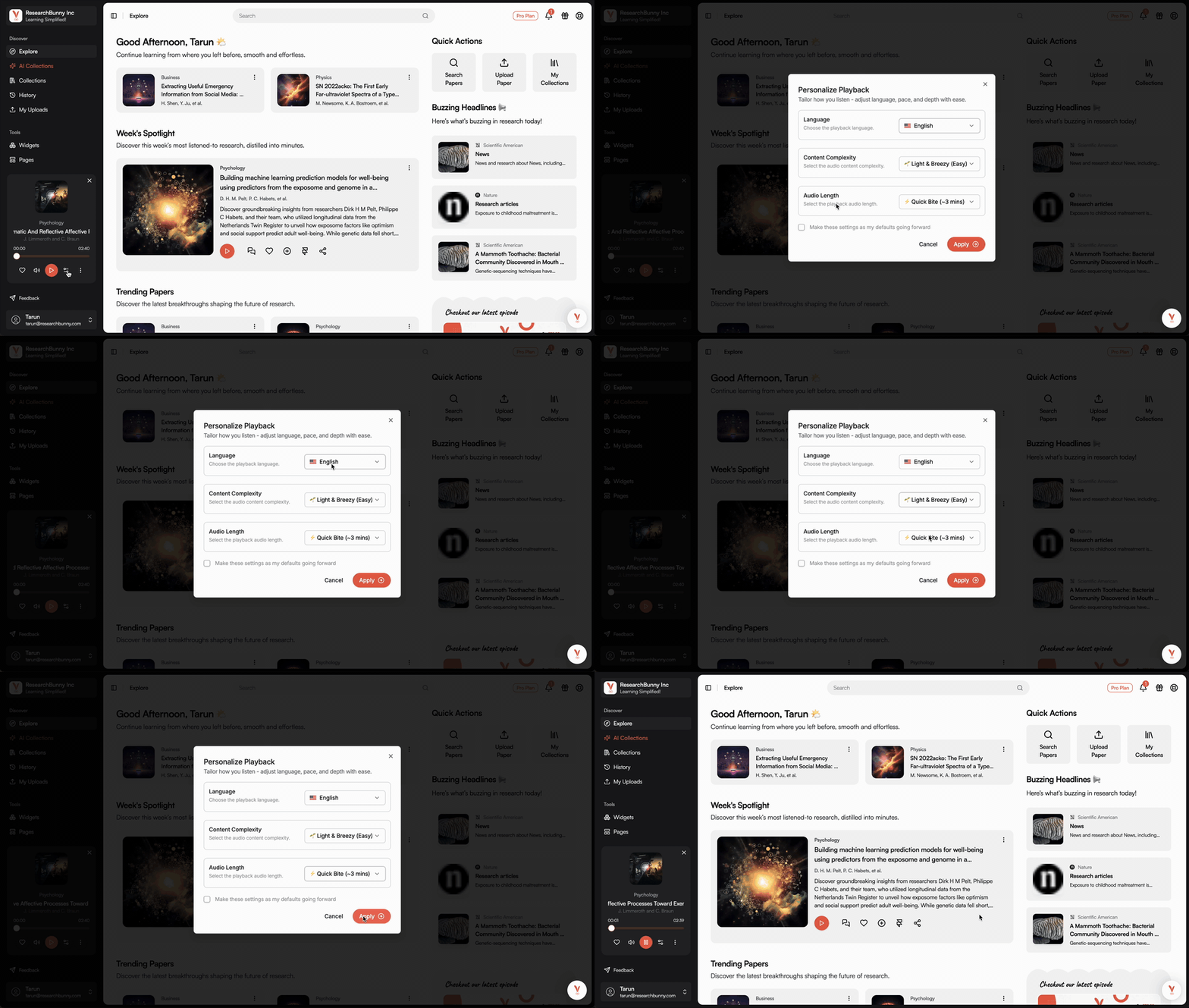
From any paper to an audio brief in minutes. No setup, no friction - just research at your pace.
Find or Upload
Search ResearchBunny's library of 200M+ papers, paste a DOI, or upload your own PDF. Any paper, instantly available.
Get Your AI Summary
Our AI reads the full paper and generates a structured audio brief — key findings, methodology, and implications — in 3, 6, or 9 minutes.
Listen Anywhere
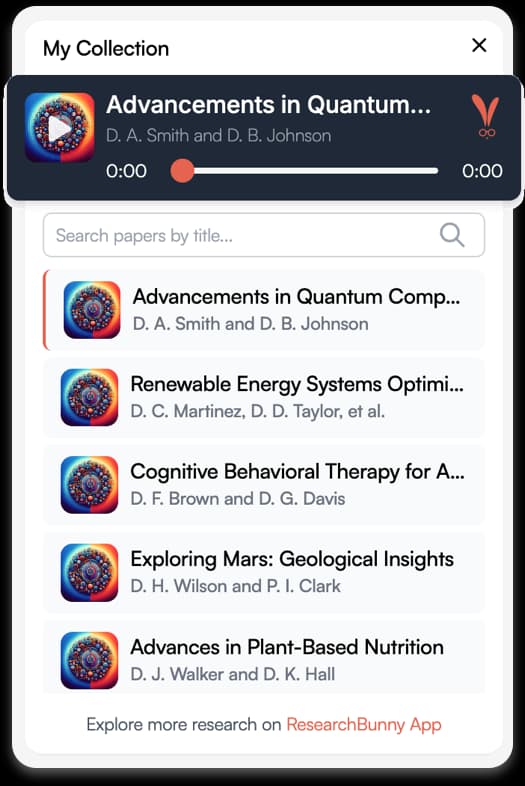
Stream on web or download to iOS and Android. Listen during commutes, workouts, or anywhere you have a spare few minutes.
Ask Bunny Answers Your Follow-Up Questions Instantly
When a paper's audio brief raises a question - about sample size, statistical approach, or how findings compare to prior work - Ask Bunny lets you pose it in plain language and get a direct answer from the paper's content. This eliminates the need to hunt through dense methods sections yourself, which is often the biggest time sink when reading academic literature. Combined with audio briefs, it means you can fully orient yourself in a new paper without ever opening the PDF.
Few Words from our
ListenersHere's What Our Subscribers Are Saying
About ResearchBunny
Questions Frequently Asked
Everything you need to know before you start.
The most effective approach combines audio triage with selective deep reading. Use ResearchBunny's 3-minute audio briefs to assess every paper on your list, then allocate full reading time only to the papers that directly advance your work. This method consistently outperforms traditional skimming because the structured summary retains hypothesis, methodology, and conclusions - the three elements most commonly lost when skimming.
Experienced researchers develop a mental schema for paper structure - they know where to look for the key claim, the experimental design, and the primary result. ResearchBunny automates this schema: its AI extracts those elements and delivers them in spoken form, so even researchers new to a subfield can orient quickly without spending years building that intuition manually.
Yes. Audio briefs are particularly effective for the screening phase of systematic reviews, where you need to assess large volumes of papers for inclusion eligibility. The consistent summary structure makes it easier to compare papers across studies, and the Ask Bunny feature can confirm eligibility criteria without requiring a full read.
Research on dual-coding suggests that audio processing activates different memory pathways than visual reading. Many ResearchBunny users report stronger recall of paper contents when they listened to a summary first, then consulted the paper for specific details. The structured narrative format of audio briefs also aids retention compared to the fragmented experience of skimming.
Free plan users receive 30 minutes of audio daily - roughly 6-10 paper briefs per day depending on chosen length. Listener plan subscribers have unlimited access, which means a motivated researcher can triage 50+ papers per week during ordinary commute and exercise time alone, far exceeding what traditional reading schedules allow.
Explore Other Use Cases
Discover more ways ResearchBunny helps researchers, students, and educators stay ahead.