

ChemistryNature Communications
Origamic Metal-Organic Framework Toward Mechanical Metamaterial
E. Jin, I. S. Lee, et al.
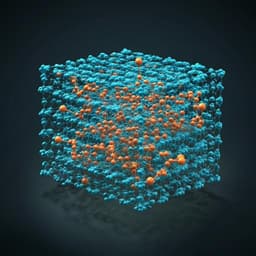
Discover the intriguing mechanical behavior of a two-dimensional porphyrinic metal-organic framework, PPF-301, engineered with flexible porphyrin linkers. This groundbreaking research reveals the molecular origami mechanics that suggest exciting applications in mechanical metamaterials. Conducted by a team of experts including Eunji Jin and In Seong Lee from Ulsan National Institute of Science and Technology.
Related Publications
Explore these studies to deepen your understanding
Adjacent work that informs or extends this paper's methodology and findings.
Chemistry
Mixed-linker strategy for suppressing structural flexibility of metal-organic framework membranes for gas separation
C. Chang, T. Ko, et al.

Chemistry
Host-guest charge transfer for scalable single crystal epitaxy of a metal-organic framework
A. Mantel, B. Stöger, et al.

Chemistry
Crystalline Hydrogen Bonding of Water Molecules Confined in a Metal-Organic Framework
J. Bae, S. H. Park, et al.

Chemistry
Electro-reduction of carbon dioxide at low over-potential at a metal-organic framework decorated cathode
X. Kang, L. Li, et al.


