
PsychologyThe Journal of Neuroscience
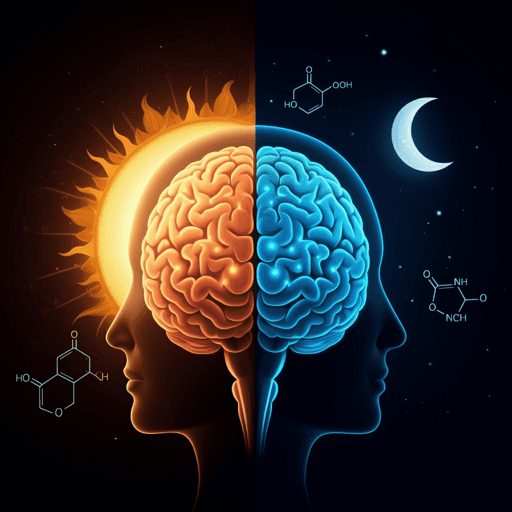
Circadian rhythms tied to changes in brain morphology in a densely-sampled male
E. M. Murata, L. Pritschet, et al.
A precision imaging study found that diurnal fluctuations in steroid hormones track striking shifts in human brain morphology: from morning to evening total brain and gray matter volumes and cortical thickness decreased while cerebrospinal fluid and ventricle size increased, driven by occipital and parietal changes. Research conducted by Elle M. Murata, Laura Pritschet, Hannah Grotzinger, Caitlin M. Taylor, and Emily G. Jacobs.
Related Publications
Explore these studies to deepen your understanding
Adjacent work that informs or extends this paper's methodology and findings.

Humanities
Walking in the shoes of others through brain-to-brain interfaces: a phenomenological approach to the generation of a collective living body
N. Liberati and D. Mykhailov

Medicine and Health
The brain at war: effects of stress on brain structure in soldiers deployed to a war zone
S. Kühn, O. Butler, et al.

Medicine and Health
A critical role of brain network architecture in a continuum model of autism spectrum disorders spanning from healthy individuals with genetic liability to individuals with ASD
B. Khundrakpam, N. Bhutani, et al.

Linguistics and Languages
Changes in the ways authors refer to themselves: a diachronic study of self-mention in English research articles
H. Wang and Z. Hu


