
Producing rigorous research is already the hard part.
The real bottleneck is everything that comes after turning dense papers into clear stories, assembling polished conference materials, and staying responsive as questions roll in from attendees, reviewers, and readers.
Most researchers spend hours rewriting the same summary, rebuilding slides for every talk, and answering identical questions across endless email chains.
ResearchBunny takes that entire workflow and compresses it with multilingual audio summaries, plain-language explainers, embeddable widgets, reusable assets, and a lightweight Q&A layer attached directly to your paper’s page.
The result: you arrive at conferences prepared, engage audiences faster, and save time across every stage of promotion.
What Success Looks Like (Requirements You’re Juggling)
To promote your work effectively and show up to conferences fully prepared, you need tools that support:
1. Professional promotion, fast
The world’s not going to read your 30-page PDF. You need:
- A clean, accurate, human-readable summary
- A 60, 180-second audio brief for people who won’t read the full paper
2. Conference-ready assets
Researchers are expected to deliver:
- A consistent abstract
- Punchy slides
- Embeddable links for decks, QR codes, session descriptions, and lab pages
3. Audience engagement without inbox chaos
You need a central place for attendees and readers to:
- Ask questions
- Get canonical, saved answers
- See context tied directly to the paper
4. Evidence for CVs, grants, and reports
Metrics like:
- Listen counts
- Region/language reach
- Top referrers
- Engagement signals are now essential for showcasing dissemination and impact.
The Time Sinks (Pain Points You Can Finally Avoid)
Without the right system, researchers lose hours to repetitive tasks:
1. Writing the same summary again and again
For emails, slides, CFP submissions, session descriptions, lab websites…
2. Rebuilding slides from scratch
Every talk requires new decks, and you still end up re-explaining context during Q&A.
3.Creating “one-off” assets that don’t scale
You make a poster, or a summary card, or a social post, but nothing is reusable across platforms.
4. Losing questions in email threads
Attendees ask the same questions. Co-authors respond differently. Context disappears.
5. Chasing metrics across platforms
Screenshots here, downloads there, analytics in five different places.
ResearchBunny eliminates these bottlenecks.
How ResearchBunny Saves Time : End to End
1. Turn Papers Into Multilingual Audio & Plain-Language Explainers
ResearchBunny lets you create:
Audio briefs (60 - 180 seconds)
Perfect for busy listeners, reviewers, and conference attendees.
Plain-language summaries
Clear, accessible explanations optimized for non-specialists, journalists, and public audiences.
18 - 25+ language versions
With controls for voice, pacing, and complexity.
Time saved: One master summary = every CFP, session description, lab website, repository record, and social post.
2. Embed Everywhere : Slides, Posters, Profiles, Repositories
Your audio summary + explainer can be embedded into:
- Slide decks
- Conference posters
- Lab pages
- OSF/Zenodo/preprints
- University profiles
- Research group websites
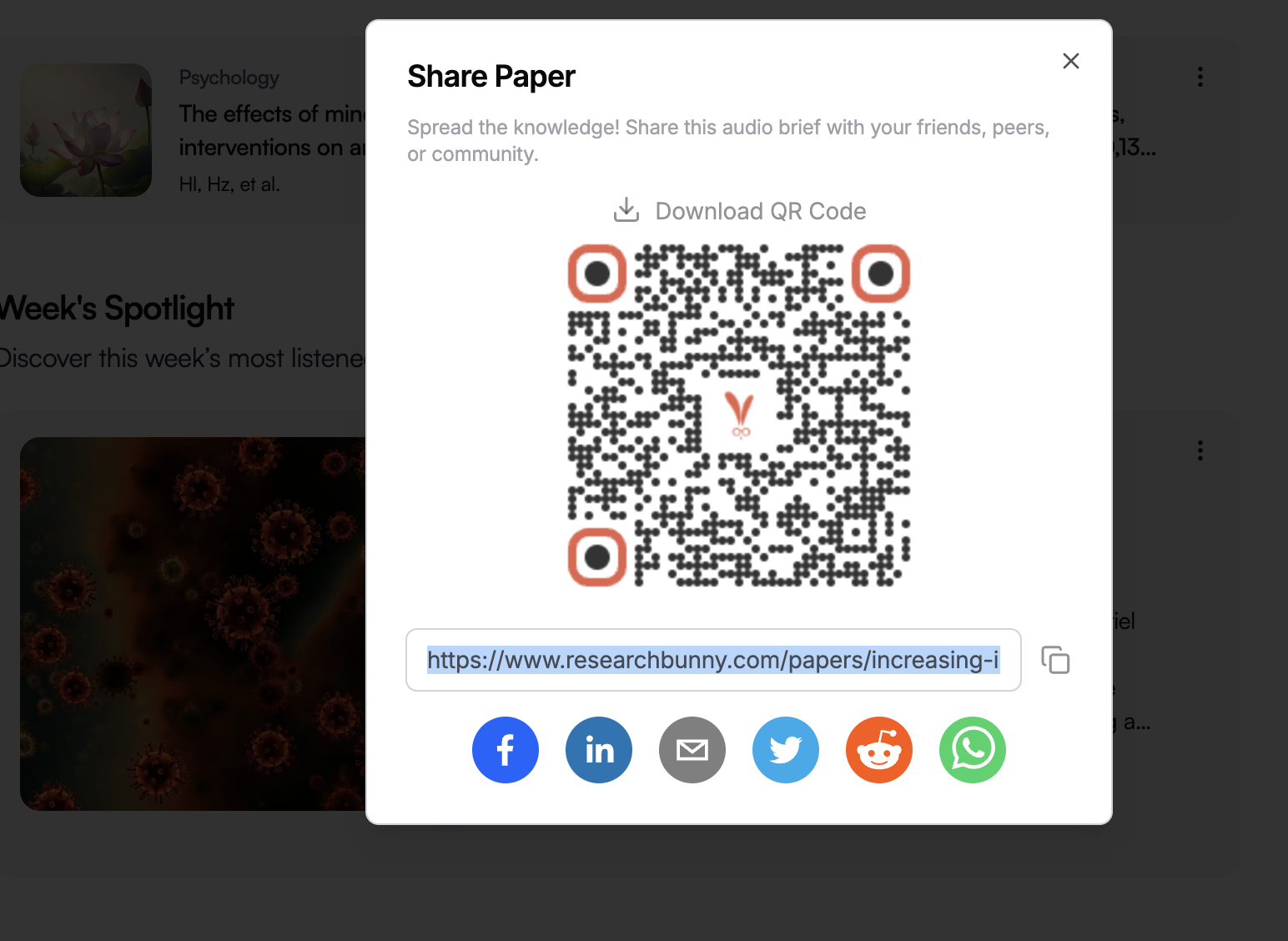
- QR codes for hallway traffic
Time saved: “Make once, use everywhere.” Every talk links to the same living explainer, no more rebuilding assets.
3. Paper-Level Q&A That Scales Automatically
Let audiences ask questions directly on your paper page
Methods, code, robustness checks, everything stays contextual.
Pin the best answers
High-value responses become saved guidance for future readers.
Loop in verified co-authors
Consistency is preserved, misinformation avoided.
Time saved: You answer a question once and never again in email threads. Your Q&A becomes a reusable FAQ that strengthens your next talk.
4. Conference Packs in Minutes
ResearchBunny helps you generate:
A clean talk abstract, A short speaker bio line, A session-ready blurb, A 3-slide elevator deck (problem → method → finding) and a poster-friendly QR panel
Linking to your audio summary + Q&A page.
Time saved: Zero blank-slide syndrome. You start from a polished template every time.
5. Lightweight Analytics for Proof (and Iteration)
Track meaningful engagement:
- Reads & listens
- Geography + language distribution
- Top referrers
- Q&A activity
Export a clean Impact Snapshot
A shareable, citable evidence pack for:
- Grant renewals
- Annual reviews
- Promotion cases
- Workshop applications
Time saved: No more spreadsheets, screenshots, or platform-by-platform hunting.
Final Thought
You’ve already done the hardest part, the research.
ResearchBunny helps you do the rest in a fraction of the time: simplify your promotion, streamline conference prep, scale your assets, and engage audiences without drowning in emails.
From prep to podium, your work becomes polished, discoverable, and ready for any stage.
🧩 Need more information? Get in touch - tarun@researchbunny.com
Follow us on LinkedIn for more tips, case studies and research-visibility insights.