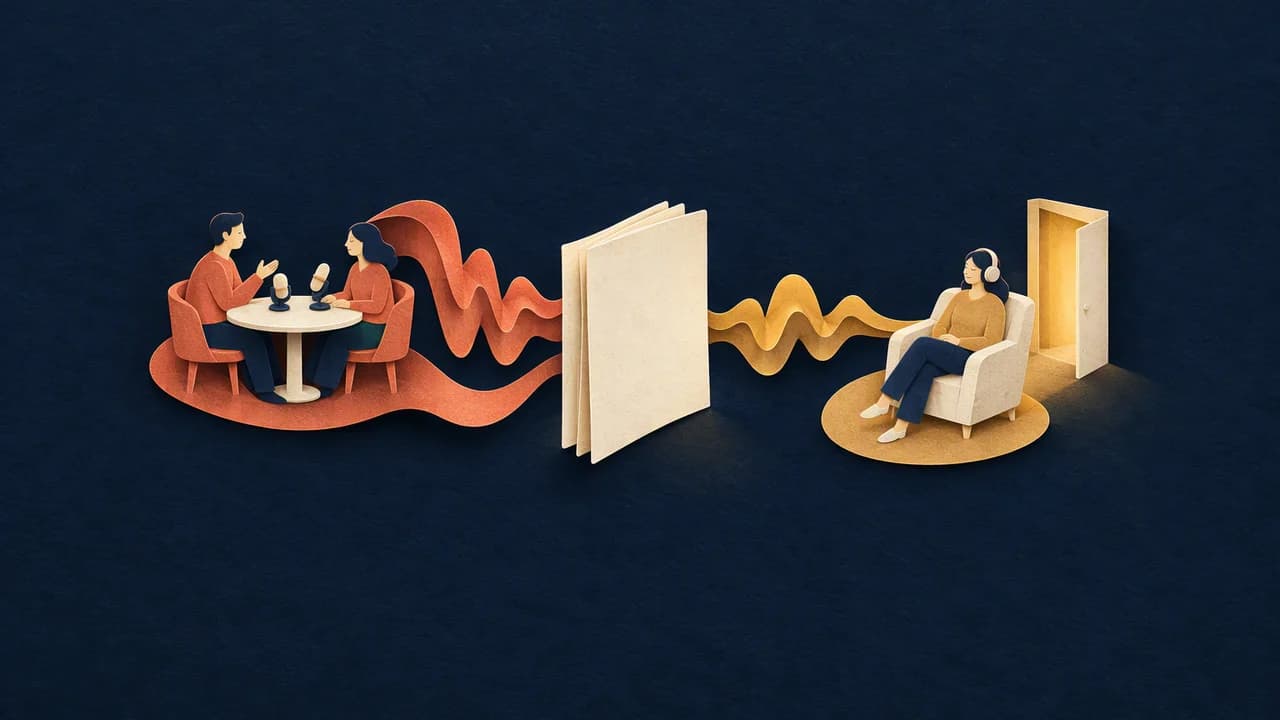
A colleague who runs a department podcast asks if you would come on and talk about your new paper. The same week, someone suggests you start your own show. Meanwhile, what you actually wanted was something a person could listen to on a commute and come away knowing what the paper found.
Those are three different jobs, and they get blurred because they all count as "audio". Picking the right one saves you a lot of recording time.
Three Things That Get Called Audio
A guest spot is a conversation on someone else's podcast. The host brings the audience and the structure, you bring the paper.
Your own podcast series is a show you plan, record, edit and publish, episode after episode, in a feed that people subscribe to in podcast apps.
An audio brief is a short, scripted summary of one paper, written for listening rather than read aloud from the PDF. It covers the question, the method, the main finding and a limitation, and it lives next to the paper on your lab page or profile instead of in a podcast feed.
What the Evidence Says About Science Podcasts
The most useful data on the second option comes from a 2019 analysis of science podcasts in Royal Society Open Science. It identified 952 English language science podcasts available in January and February 2018. It is a snapshot of what was being produced, not a measure of audiences or impact, but it is sobering for anyone thinking about starting a show:
- 65% of the series were hosted by scientists, and 77% were aimed at public audiences.
- Only 46% were active, meaning they had released an episode in the three months before sampling. 40% had not released one for over a year.
- 33% had produced fewer than 10 episodes.
- Only 24% had any overt financial income.
- Series affiliated with an organisation produced more episodes (median 24) than independent ones (median 16).
The same paper notes that podcasts can be made with readily available equipment, even a single smartphone, and that listeners like them because they can listen while doing something else. It also notes that audience engagement metrics for podcasting were, at the time, either not well developed or not publicly available. The barrier to starting is low. Keeping going is the hard part: in that snapshot, more than half the shows had not released an episode in the previous three months.
Side by Side
| Guest on an existing podcast | Your own podcast series | Scripted audio brief | |
|---|---|---|---|
| Your effort | Prepare, then one recording session | Planning, recording, editing and publishing for every episode | One script, checked against the paper |
| Who hears it | The show's existing listeners | Whoever you build up over time | People who find your paper or your page |
| Control of wording | Low: the conversation is live and the host edits | High | High: every line is written in advance |
| Where it lives | The host's feed | Your feed in podcast apps | Next to the paper: lab page, profile, publication list |
| Best for | Reaching a new audience with a story | A long-term research programme with many outputs | One paper that should be understood quickly |
None of these is better in general. They answer different questions: "who already has listeners?", "do I want to be a broadcaster?" and "what should someone hear when they land on my paper?"
Make Any Audio Readable Too
Audio on its own is hard to skim, search or quote, and some listeners cannot use it at all. Podcast platforms help here. At the time of writing (October 2026), Apple says it automatically generates transcripts after a new episode is published, for podcasts in English, Danish, Dutch, Finnish, French, German, Italian, Norwegian, Portuguese, Spanish and Swedish, on iOS 17.4 or later. Transcripts are not displayed for episodes that are not distributed to the Apple Podcasts catalogue.
Audio you host on your own web page gets no automatic transcript, so publish the script or a transcript beside it. For a guest spot, ask the host to put your paper's DOI in the show notes, which the 2019 study describes as supplementary text that can include hyperlinks and references.
A worked example: one paper, two audio plans
Say you have a psychology paper on sleep and exam performance, and you are invited onto your department's podcast.
- For the guest spot, prepare three points in plain words: the question, the finding, and one limitation you will say even if not asked. Send the host the paper title, DOI and a one-line summary for the show notes.
- For the audio brief, write a script of a few hundred words in short spoken sentences. Name the paper and authors at the start, say each number once and rounded, repeat the main finding at the end, and close with where to read the paper.
- Then place them. The episode lives in the host's feed. The brief goes on your profile and lab publications page, where people looking at the paper will find it.
The guest spot borrows an audience. The brief serves the people who were already looking for your work.
Where Amplify Fits
Amplify makes the audio brief, not a podcast. It is generated from the PDF you upload and nothing else, in English plus 21 more languages on request (22 in total, including Spanish, Mandarin, German, French, Portuguese, Hindi, Japanese and Korean). Like every Amplify format, it carries the title, the authors and a link back to the paper of record.
It arrives as three variants that you can edit line by line or regenerate, a subject-matter reviewer reads every draft, and nothing publishes until you approve it. An embeddable widget, one script tag per page, puts the audio brief beside the paper on your own page, along with the summaries, video and infographic, and readers can also chat with the paper. Analytics show listens and languages, which helps when a grant report asks what happened next.
If you would rather have an AI-hosted, conversational take on your paper, see how NotebookLM's Audio Overview compares for your own paper. For why more languages widen who can listen, see multilingual research summaries.
Pick the audio format by the job: a borrowed audience, a long-term show, or a clear summary waiting next to the paper. For many papers the last one is enough on its own, and some deserve all three.